...RUN ENTIRELY BY CHILDREN'S AUTHORS!
If you'd like to see what all the excitement is about, please click on
AN AWFULLY BIG BLOG ADVENTURE.
I'll be there on 9th July with a BRAND NEW VIDEO. But that's all I'm saying for now...!
Monday, 20 June 2011
Tuesday, 14 June 2011
A Writer's Right to Die - My Reaction to Terry Pratchett
I've been away for a while. Thinking. Dreaming. Playing with words. But I've chosen to come back today and write about my personal reaction to a difficult and emotive subject which polarises opinion. You'll probably know what I'm talking about. Terry Pratchett's BBC documentary, Choosing to Die was screened on the BBC last night. I cried throughout, though not for the reasons you may imagine. It was a dignified, wonderful and moving programme made with unflinching bravery and infinite compassion. Much will be said on both sides of the fence about the rights and wrongs of assisted suicide. I can only speak for myself here.
Terry Pratchett is above anything else a writer. He has long been one of my favourite authors in the world. He makes me laugh, he makes me cry (more crying), he makes me think how damned clever he is and how I wish I could construct the kind of punes he does without looking like a complete fule. He also happens to have Alzheimer's. He's made 'coping with it' jokes about that--at the beginning wondering "what kind of vegetable would I be?". Now, as the condition progresses, he is confronting his own end--and how he would want that to occur.
"When I can no longer write my books, I am not sure I want to go on living" he says in the programme.
I understand that. I do so understand that. In the last weeks, I have had a scare with my eyes. I have thought hard about not being able to read, to see--to type the words which demand to be let out of my head. It was and is a fearful terror and it made (and makes) me feel sick and scared and lost. So, as a writer, not to be able to rely on one's brain to come up with the goods--to lose the words which make you who you are--must be unimaginably horrifying to contemplate. Terry says that the things which would make him consider ending his own life are:
"Not being able to dictate any more; not being able to be a writer any more; not being able to communicate."
There are many dreadful and horrific things going on in our world right now. Please, don't think I'm ignoring those when I say that one of the greatest pleasures in my life is looking forward to a new Pratchett novel. A world in which that could no longer happen would be less bright for me, but I know that it will occur, probably sooner rather than later. (I feel the same way about the fact that there will now never be another Diana Wynne Jones book, by the way). But that is a very personal and probably selfish reaction. More importantly, what Terry's programme has crystallised for me is that I do now believe more than ever before that anyone with a terminal or incurable condition should have the right to choose the manner of their death and the time of it, if they wish to do so and are mentally capable of making that decision for themselves. Very few can afford £10,000 to go to Dignitas. Those who do go there from this country would much rather die in their own homes with their own things around them, with no fear that their loved ones will be prosecuted.
"Who owns your life?" Terry asks.
Who owns me? I do. And if I ever find myself in Terry's position or that of Andrew Smedley, Rob Colgan or Hugo Claus, I would like to have the choice of when to let my words go quiet. Or not to let them go quiet. That is the nature of the word 'choice'.
You can find out more about Dignity in Dying here.
Terry Pratchett is above anything else a writer. He has long been one of my favourite authors in the world. He makes me laugh, he makes me cry (more crying), he makes me think how damned clever he is and how I wish I could construct the kind of punes he does without looking like a complete fule. He also happens to have Alzheimer's. He's made 'coping with it' jokes about that--at the beginning wondering "what kind of vegetable would I be?". Now, as the condition progresses, he is confronting his own end--and how he would want that to occur.
"When I can no longer write my books, I am not sure I want to go on living" he says in the programme.
I understand that. I do so understand that. In the last weeks, I have had a scare with my eyes. I have thought hard about not being able to read, to see--to type the words which demand to be let out of my head. It was and is a fearful terror and it made (and makes) me feel sick and scared and lost. So, as a writer, not to be able to rely on one's brain to come up with the goods--to lose the words which make you who you are--must be unimaginably horrifying to contemplate. Terry says that the things which would make him consider ending his own life are:
"Not being able to dictate any more; not being able to be a writer any more; not being able to communicate."
There are many dreadful and horrific things going on in our world right now. Please, don't think I'm ignoring those when I say that one of the greatest pleasures in my life is looking forward to a new Pratchett novel. A world in which that could no longer happen would be less bright for me, but I know that it will occur, probably sooner rather than later. (I feel the same way about the fact that there will now never be another Diana Wynne Jones book, by the way). But that is a very personal and probably selfish reaction. More importantly, what Terry's programme has crystallised for me is that I do now believe more than ever before that anyone with a terminal or incurable condition should have the right to choose the manner of their death and the time of it, if they wish to do so and are mentally capable of making that decision for themselves. Very few can afford £10,000 to go to Dignitas. Those who do go there from this country would much rather die in their own homes with their own things around them, with no fear that their loved ones will be prosecuted.
"Who owns your life?" Terry asks.
Who owns me? I do. And if I ever find myself in Terry's position or that of Andrew Smedley, Rob Colgan or Hugo Claus, I would like to have the choice of when to let my words go quiet. Or not to let them go quiet. That is the nature of the word 'choice'.
You can find out more about Dignity in Dying here.
Labels:
Choosing to Die,
Dignity in Dying,
Lucy Coats,
Terry Pratchett
Friday, 29 April 2011
A Meditation on Turning Fifty
This week, with the whole country covered in bunting and Union Jacks (how kind of everyone to decorate for my birthday), I celebrate reaching my half-century. As a change from the clangour of royal wedding bells and revelations, here's a small poetic insight into how it feels to me....
Meditation on Turning Fifty
Why April is the cruellest month—well,
I’ve never understood Tom’s take on that.
I’m more of a Geoffrey goodwif, me.
My April has sweet showers, is mild, beneficent,
full of thrusting green and skylarks.
But if any April were to be cruel, it would be this.
Here I stand, damp and peeling
out of my first half-century carapace,
skin sloughing like a fat, burnt snake,
whirling and gurgling down the drain;
stripped and flaking evidence
of the life I’ve led so far.
Will the other side of April
be a slow slide down into darkness--
fifty dulled roots in a dead lilac land? No.
I defy sad Tom and his heap of broken images.
Instead, I shall wear stockings of a fine scarlet red
to adorn my pilgrimage to winter.
Labels:
Geoffrey Chaucer,
Lucy Coats,
poetry,
TS Eliot
Wednesday, 27 April 2011
The Royal Wedding Revelations - EXCLUSIVE! (Part 3)
One thing I forgot to tell you about in yesterday's Buckingham Palace story was the Royal Loos. No good writer or journalist-to-be could ever resist a sneaky peek into the smallest rooms in the palace--I was no exception. They are positively...well...regal, dear readers. Also commodious and throne-like. Quite literally. I have never been seated on so many acres of polished wood to pee, nor been anywhere lavatorial with such grandiose silken wallpaper. The overhead flush, worked by a long chain finished with a crested china pull, sounded just like a roaring Balmoral waterfall. But enough of Royal conveniences. I believe I promised you a Cathedral...
Wednesday 29th July 1981, inside St Paul's Cathedral, London
We'd all been up late the night before, mingling with the massive crowds in the darkness of Hyde Park, cheering en masse as the fireworks went up in a fiery paean to tell the watching world that tomorrow there would be a Royal marriage, a new princess for Britain. As the last firework burned out, and I walked back through the joyful, buzzing streets of Kensington with my companions, it seemed to me a private, personal signal that the friend I knew so well would now enter into a life unimaginable to either of us only four short years before, as we lay in our adjoining iron boarding school bedsteads, chattering about boys and lessons and the grimness of certain teachers.
The hairdresser visited early, sticking pins in strategic places and making sure hats and hair were perfectly aligned. Bag, gloves (grey short ones for me this time), shoes polished and pristine, makeup applied, don't forget to wee at the last minute because it will be a long day--the girls with pearls (of course we wore pearls!) were ready to go. It was the strangest of feelings, being driven along that sunlit wedding route lined with what seemed like millions of smiling faces, Union Jacks, and those odd square periscopes which stuck up everywhere like small chimneys. We waved frantically (in a most undignified and unregal way) through the car windows of course--what other opportunity would we ever get to feel like queens? And every time we did there were loud cheers from behind the metal barriers. Even the lined out policemen were grinning at us. It was nine o' clock in the morning, and we had two hours to go before lift-off. The smaller West Door of St Paul's was open, and a crowd of assorted top hats and morning suits and uniforms were pouring in, together with a whole rainbow garden of dresses and feathered, sequinned, chiffoned, strawed and silken creations on heads.
The small bright-blue entry ticket told me to go to Nave North A. If you look very carefully at the aerial footage from that day, you can see me sitting half way up the main aisle on the left hand side, fidgeting as I listen to the music. And boy, was there a lot of music while all the grandees got into place. Howells and Tippett, Britten and Bliss--all the Great British Composers of the 20th century boomed out of those massive organ pipes. The cheers from outside grew louder and louder as each car arrived. Heads craned round unashamedly, who would be next through the doors? Who could we recognise and wave at from our own lives? Jane? Sarah? Carolyn? Virginia? Annie? Charles? We all studied our ceremonial programmes minutely and a wind of whispers rose up into the dome and circled and swirled in a tornado of discreet sound as some of the Heads of State and foreign royals were conducted to their seats, followed by the Gentleman Ushers with the more minor members of Royal Family.
Then it was the turn of the Ecclesiastical Procession. Virgers, the Crossbearer, the Taperers, The Choristers--on and on they went in a rustling, starched flood of snowy white surplice, red robe, and finally the gold and purple of high church office. Diana's mother Frances arrived next--looking elegant if a little lonely in floaty powder-blue chiffon--very different from the relaxed woman in sun-faded jeans and cotton shirts I remembered so well from one long, hot Scottish summer.
Shortly afterwards we heard barked military orders as the lining parties shuffled into their immaculately dressed ranks on the steps, the main doors of the Cathedral were flung open, and the procession of Foreign Crowned Heads arrived, resplendent in uniforms, bright sashes, medals and Orders. Monaco, Liechtenstein, Luxembourg, the Netherlands, Spain, Sweden, Norway and Belgium settled in their seats. Eighteen minutes to go. When would the rest of them arrive? Surely soon, we said hopefully, wriggling our numb bottoms on the hard pews.
The cheers grew louder and more frenzied. There was a clattering of hooves and more shouted orders. As the National Anthem started to play outside, we rose to our feet as if pulled upwards on strings. The Mayor of London, carrying the Pearl Sword held high in front of him, came down the centre aisle to the strains of a Purcell rondeau, followed by the Queen, blue-clad and serene with Prince Philip's braid-bedecked and bemedalled figure marching beside her and all her family behind. The cathedral swished and swayed like a garden in the wind as we all bobbed and bowed.
Exactly six minutes later, more clattering of hooves and the loudest cheers yet as the bridegroom and his middle brother emerged from the 1902 State Landau to yet more National Anthem, and were joined by his youngest brother in the Dean's Aisle, where they waited for precisely five minutes until the cheers from outside built to a previously unheard pitch of screaming excitement. The Glass Carriage had arrived, the Bride and her yards of crumpled silk entered to a high, wild fanfare of trumpets that put a lump in my throat and raised all the hairs on the back of my spine. The great doors closed, and we were all shut inside as she walked down the aisle, a living virginal sacrifice on the arm of her father the earl, veil down, invisible and yet the most visible woman in the world at that moment.
As all the world knows, she stumbled over her marriage vows, and at that moment--the moment when she mixed up her Arthurs and her Philips--the whole place seemed to take a silently sucked-in breath. I remember wondering if it still counted if you got it wrong at the altar--whether you were still properly married--whether it was a bad omen. And then I forgot it, as the new Princess walked up the aisle on the arm of her Prince, eyes moving over the congregation, seeking out those she knew. She saw us all, her friends, sitting there like a row of brightly-coloured ducks , and just for a millisecond her eye flickered in a tiny but unmistakeable wink above that trademark smile. It was a very Diana moment. And then it was all over. Off she drove in the open landau into that short but intense period of history with its well-known tragic finish--away from the normal everyday life of university and work I and her other friends returned to all too soon.
But for those three days--for those three days I was right inside what seemed then like the biggest and most unforgettable fairytale ever told. And like the cheering crowds outside, on that particular day I too believed that fairytales have happy endings. This Friday, nearly thirty years later, no doubt I shall believe it all over again for Prince William and Kate Middleton in Westminster Abbey as I watch them exchange their marriage vows on my television, along with millions of other viewers. But just in case, I'll also be sending up a prayer to my dear friend on her pearly cloud that this time, for her son and daughter-in-law, history will turn out differently. I know she'll be watching too. She wouldn't miss it for all the world.
Click HERE for Part 1 of The Royal Wedding Revelations
Click HERE for Part 2 of The Royal Wedding Revelations
| Photograph copyright Lucy Coats 2011 |
We'd all been up late the night before, mingling with the massive crowds in the darkness of Hyde Park, cheering en masse as the fireworks went up in a fiery paean to tell the watching world that tomorrow there would be a Royal marriage, a new princess for Britain. As the last firework burned out, and I walked back through the joyful, buzzing streets of Kensington with my companions, it seemed to me a private, personal signal that the friend I knew so well would now enter into a life unimaginable to either of us only four short years before, as we lay in our adjoining iron boarding school bedsteads, chattering about boys and lessons and the grimness of certain teachers.
| Photograph copyright Lucy Coats 2011 |
As we entered, Ushers handed us two large white booklets, one a Guide to the Ceremonial so we'd all know who was who as they entered, and the other an Order of Service decorated in gold and red and showing music and hymns and all the normal business of a wedding.
| Photograph copyright Lucy Coats 2011 |
Then it was the turn of the Ecclesiastical Procession. Virgers, the Crossbearer, the Taperers, The Choristers--on and on they went in a rustling, starched flood of snowy white surplice, red robe, and finally the gold and purple of high church office. Diana's mother Frances arrived next--looking elegant if a little lonely in floaty powder-blue chiffon--very different from the relaxed woman in sun-faded jeans and cotton shirts I remembered so well from one long, hot Scottish summer.
| Photograph copyright Lucy Coats 2011 |
Shortly afterwards we heard barked military orders as the lining parties shuffled into their immaculately dressed ranks on the steps, the main doors of the Cathedral were flung open, and the procession of Foreign Crowned Heads arrived, resplendent in uniforms, bright sashes, medals and Orders. Monaco, Liechtenstein, Luxembourg, the Netherlands, Spain, Sweden, Norway and Belgium settled in their seats. Eighteen minutes to go. When would the rest of them arrive? Surely soon, we said hopefully, wriggling our numb bottoms on the hard pews.
The cheers grew louder and more frenzied. There was a clattering of hooves and more shouted orders. As the National Anthem started to play outside, we rose to our feet as if pulled upwards on strings. The Mayor of London, carrying the Pearl Sword held high in front of him, came down the centre aisle to the strains of a Purcell rondeau, followed by the Queen, blue-clad and serene with Prince Philip's braid-bedecked and bemedalled figure marching beside her and all her family behind. The cathedral swished and swayed like a garden in the wind as we all bobbed and bowed.
Exactly six minutes later, more clattering of hooves and the loudest cheers yet as the bridegroom and his middle brother emerged from the 1902 State Landau to yet more National Anthem, and were joined by his youngest brother in the Dean's Aisle, where they waited for precisely five minutes until the cheers from outside built to a previously unheard pitch of screaming excitement. The Glass Carriage had arrived, the Bride and her yards of crumpled silk entered to a high, wild fanfare of trumpets that put a lump in my throat and raised all the hairs on the back of my spine. The great doors closed, and we were all shut inside as she walked down the aisle, a living virginal sacrifice on the arm of her father the earl, veil down, invisible and yet the most visible woman in the world at that moment.
| Photograph copyright Lucy Coats 2011 |
As all the world knows, she stumbled over her marriage vows, and at that moment--the moment when she mixed up her Arthurs and her Philips--the whole place seemed to take a silently sucked-in breath. I remember wondering if it still counted if you got it wrong at the altar--whether you were still properly married--whether it was a bad omen. And then I forgot it, as the new Princess walked up the aisle on the arm of her Prince, eyes moving over the congregation, seeking out those she knew. She saw us all, her friends, sitting there like a row of brightly-coloured ducks , and just for a millisecond her eye flickered in a tiny but unmistakeable wink above that trademark smile. It was a very Diana moment. And then it was all over. Off she drove in the open landau into that short but intense period of history with its well-known tragic finish--away from the normal everyday life of university and work I and her other friends returned to all too soon.
But for those three days--for those three days I was right inside what seemed then like the biggest and most unforgettable fairytale ever told. And like the cheering crowds outside, on that particular day I too believed that fairytales have happy endings. This Friday, nearly thirty years later, no doubt I shall believe it all over again for Prince William and Kate Middleton in Westminster Abbey as I watch them exchange their marriage vows on my television, along with millions of other viewers. But just in case, I'll also be sending up a prayer to my dear friend on her pearly cloud that this time, for her son and daughter-in-law, history will turn out differently. I know she'll be watching too. She wouldn't miss it for all the world.
Click HERE for Part 1 of The Royal Wedding Revelations
Click HERE for Part 2 of The Royal Wedding Revelations
Tuesday, 26 April 2011
The Royal Wedding Revelations - EXCLUSIVE! (Part 2)
I left you back in 1981, on tenterhooks to find out What Happened Next in this exclusive tale of royal revelries at Buckingham Palace, where we were about to enter the realms of Disaster Number Two. The Curtsey to The Queen at the top of that huge curving sweep of red-carpeted stairs...
Curtseys to queens, however much practiced at home in front of a mirror, are much more difficult than they look. I tripped over my own high-heeled feet, dear readers. Fell flat on my face in front of Her Majesty and assorted regal personages who all looked rather bemused at this clumsy rose-coloured vision sprawled in front of them. Plus one not-as-yet-Royal personage who, (knowing my normal klutz mode all too well), was not bemused at all but had a fit of giggles most unbefitting a princess-to-be. I collected myself, wondering if I'd committed some terrible act of lèse-majesté, and fled down the East Gallery, wrapping the shreds of my dignity around me. Standing at the end of the gallery were a number of nice bewigged footman handing out the champagne. That nearly led to Disaster Number Three.
Remember my borrowed begloved finery? Have you ever tried eating and drinking with Long Kid Gloves on? Take my advice. Don't. They make your fingers thick and clumsy like thumbs. I managed to hold onto the champagne (goblet not flute, of course), taking large swigs to calm my frayed nerves. Then, having been too strung up to eat anything beforehand, I slipped into the Ball Supper room, spread with a sumptuous buffet, for a tiny snack. The rarest of roast beef from the royal herds and pink poached salmon with cucumber scales lay on ornate silver dishes. Fishy eyes stared disapprovingly as I tried to manhandle glass, plate and cutlery with increasing desperation. Cutting beef with a fork? One handed? With gloves on? When you're a klutz? Just before everything tipped off the plate and all over some unsuspecting duchess, I put it down and decided to go hungry. Snacks were off the menu and The Long Kid Gloves had won. More champagne, that was the answer, and some serious people-watching.
I wasn't all alone in that huge, awe-inspiring palace full of strangers. My friends and I went exploring together. But even then, long before writing became my profession, I had my writer's eyes on, noticing and filing stuff away in my brain. In the State Dining Room, set against a blaze of deep red and white and mirrored gold, there was Mrs Thatcher, a Prime Minister to love or hate intensely, according to your political views. Her hair was a magnificent blondish helmet with not a coiffed hair astray, and she was dressed in long heavy silver-grey brocade, like rather shapeless designer armour--a Tory warrior incarnate. Denis stood one step behind as she held court under the gaze of a huge bevy of royal portraits, correct and grey-haired in white tie and tails, comforting gin in hand. There in the Ballroom was the King of Spain, black hair shining, very upright and laden with glittering orders, dancing with his queen to the sound of Kenny Ball and his Jazzmen. In the Blue Drawing Room we joined Prince Andrew by the bar--young, thin and glamorous then, and surrounded by a horde of pretty girls (us included), all hoping he'd take us into the Disco to dance the night away. Everywhere there were enormous urns of opulent heavy-smelling flowers, and large tethered bunches of blue and silver helium balloons decorated with the triple feathers of the bridegroom.
Princess Grace of Monaco floated past me trailing golden film star glamour--once just another young girl who had married her prince in a fairytale wedding. And then there was Princess Margaret, who hadn't. Dressed in a bright yellow dress that outshone the tall brocade curtains, smoking like a chimney, she sat, legs akimbo, in the White Drawing Room (with the Cocktail Bar nicely handy) surrounded by adoring Young Things, roaring with laughter. Hers is the image that sits in my mind most clearly from that night--she looked like a blazing comet, full of dangerous fun and fire.
As we entered the Picture Gallery and fell into the swirling mass of colour and chatter echoing off the curved glass roof, we bumped into Prince Charles, standing alone and peering at the floor. He had just lost a cufflink. I found myself on my knees before royalty for a second time that night, scrabbling around on the swirly carpet for a small gold object. The royal cuffs restored to neatness, a little light chat ensued and then the prince was whisked away to talk to more eminent personages. I curtseyed rather more successfully this time and headed into the Green Drawing Room. The Throne Room lay beyond, closed off but visible, the two velvet covered chairs under the red-and-gold canopy somehow seeming small and insignificant beside the sight of a red-and-gold clad Indian maharajah, with a ruby in his head-dress which, while not quite the size of a pigeon's egg, must have been at least the size of a quail's.
I'll leave you with the thought of me, swaying like a large pink blossom round the Ballroom floor with a nameless young man, watching the slight awkwardness of the royal bride and groom-to-be dancing to the husky sound of Errol Brown and Hot Chocolate singing You Sexy Thing. Live of course.
Tomorrow, I'll take you right inside St Paul's with me. And tell you about The Wink...
Click HERE for Part 1 of The Royal Wedding Revelations
Curtseys to queens, however much practiced at home in front of a mirror, are much more difficult than they look. I tripped over my own high-heeled feet, dear readers. Fell flat on my face in front of Her Majesty and assorted regal personages who all looked rather bemused at this clumsy rose-coloured vision sprawled in front of them. Plus one not-as-yet-Royal personage who, (knowing my normal klutz mode all too well), was not bemused at all but had a fit of giggles most unbefitting a princess-to-be. I collected myself, wondering if I'd committed some terrible act of lèse-majesté, and fled down the East Gallery, wrapping the shreds of my dignity around me. Standing at the end of the gallery were a number of nice bewigged footman handing out the champagne. That nearly led to Disaster Number Three.
| Photograph copyright Lucy Coats 2011 |
Remember my borrowed begloved finery? Have you ever tried eating and drinking with Long Kid Gloves on? Take my advice. Don't. They make your fingers thick and clumsy like thumbs. I managed to hold onto the champagne (goblet not flute, of course), taking large swigs to calm my frayed nerves. Then, having been too strung up to eat anything beforehand, I slipped into the Ball Supper room, spread with a sumptuous buffet, for a tiny snack. The rarest of roast beef from the royal herds and pink poached salmon with cucumber scales lay on ornate silver dishes. Fishy eyes stared disapprovingly as I tried to manhandle glass, plate and cutlery with increasing desperation. Cutting beef with a fork? One handed? With gloves on? When you're a klutz? Just before everything tipped off the plate and all over some unsuspecting duchess, I put it down and decided to go hungry. Snacks were off the menu and The Long Kid Gloves had won. More champagne, that was the answer, and some serious people-watching.
| Photograph copyright Lucy Coats 2011 |
| Photograph copyright Lucy Coats 2011 |
| Photograph copyright Lucy Coats 2011 |
I'll leave you with the thought of me, swaying like a large pink blossom round the Ballroom floor with a nameless young man, watching the slight awkwardness of the royal bride and groom-to-be dancing to the husky sound of Errol Brown and Hot Chocolate singing You Sexy Thing. Live of course.
Tomorrow, I'll take you right inside St Paul's with me. And tell you about The Wink...
Click HERE for Part 1 of The Royal Wedding Revelations
Monday, 25 April 2011
The Royal Wedding Revelations--EXCLUSIVE! (Part 1)
Ooh! Is Scribble City Central going to reveal secret information about Kate's Dress? Or The Honeymoon Location? Or what happened on William's Stag Night? Well, no...not exactly. Because I'm not talking about THIS Royal Wedding. I'm talking about the one on 29th July 1981. The one where William's parents tied the knot.
So where's the exclusive scoop in that, I hear you ask, (in maybe slightly disappointed tones)?
Well, let's just say I have a bit of a never-told-before insider's view of how things really happened all those years ago....
That wedding will be thirty years gone this July--so long ago that it qualifies as ancient history really. I guess I can write about how I was more closely involved than most now. And this week, when my old friend's son is getting married to the woman he loves with (not quite) all the fanfare and pomp that went with his parents' seems like the appropriate time to do so for the very first time. So you are getting a Royal Wedding Exclusive really--see, I never disappoint my loyal readers!
On 24th February 1981, a beautiful young woman called Lady Diana Spencer got engaged. To the Prince of Wales. So far, so public knowledge....
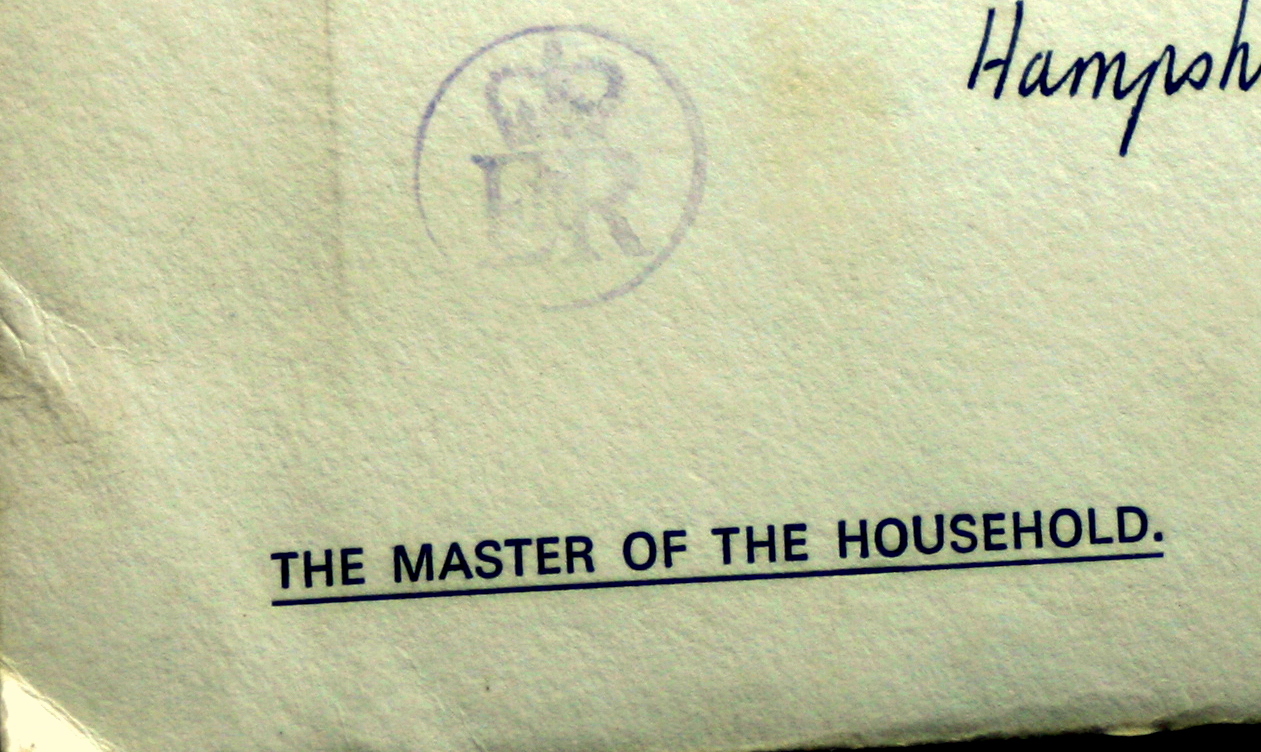
Now we'll skip right to the part where postman John rapped on the kitchen window of my parents' house one early June morning with a big grin on his face. "Got something here I think you'll want to open, Lucy," he said, handing over two large stiff cream envelopes both addressed to me. One had heavy black italic writing and was stamped in royal purple with 'Lord Chamberlain, St James's Palace' and a discreet purple crown. The other was marked 'The Master of the Household' and had a small round and becrowned EIIR in the bottom left corner.
'The Lord Chamberlain is commanded by The Queen and The Duke of Edinburgh...' said the first, once I'd managed to find a sharp knife and slit it open with my slightly shaky hands.
'The Master of the Household is commanded by her Majesty...' said the second.
And so it was that a scruffy, impoverished young Edinburgh University student found that, like Cinderella, a fairy godmother (in the shape of a future princess) had waved a magic wand and invited her not only to be one of the 2,600 guests at the wedding of the century, but also to the very exclusive celebration ball at Buckingham Palace two days before. Tiaras could be worn by ladies if so desired, said the rather scary dress instructions enclosed. No worry there for me--I didn't desire, didn't have one and was advised that flowers would do. Decorations and Orders could be worn by gentlemen. That was no problem either. But then there was a strict mention of Long Kid Gloves.
Long Kid Gloves. I distinctly remember that was when I started to panic. Where did one beg, borrow or steal Long Kid Gloves from? Hearing of my predicament, a lady in the village came to the rescue, and lent me her precious pair, secreted in tissue paper since her own Presentation at Court circa 1925. Then there was The Ball Dress. That was Disaster Number One. I took all the money I had left from my student grant (not much) to London with me--and promptly had my bag stolen. In Fortnum and Mason's. I've never felt quite the same about the place since. Luckily my Real Godmother (small as a fairy but rather more solid) came to the rescue, and whisked me off to a tiny dressmaker in South Molton Street. She insisted, being rather old-fashioned, that pink was the colour for gels orf to the Palace. So pink it was. Rather a lot of pink as you see. I felt like a rose-coloured ship in full sail. With added petals.
Real Godmother also bought me a small round blue hat-with-veil to go with my St Paul's ensemble. Quite honestly, I should have been shot for crimes against fashion. Grey and purple checks with a blue hat? Still, I like to think that my dewy twenty year-old youth and beauty drew onlookers' eyes away from that truly awful outfit. And if not, at least there was the perky little hat veil.
Monday 27th July 1981 was hot and sultry. My long chestnutty hair was pouffed and plaited and teased and pinned within an inch of its life by the Hampshire hairdresser. Sprayed too, for the first time ever, so it stayed pristine and perfect for the night to come. There were several of us in the car on the way to the palace, dresses squashed together so tight the petticoats squeaked--the others were chattering excitedly, but all I remember is feeling awe and terror as we drove past the saluting guardsmen, through Those Gates, and swept round and under the columns of the inner portico. There was a queue of guests lining the long double sweep of red-carpeted stair with its ornate curving balustrade. At the top waited an imposing line of royals, arrayed in glittering jewels, silks and satins, with small diamond-framed family portraits pinned to their shoulders on incongruously faded scraps of silken ribbon. The tiaras, crowns, medals and Orders were out in force everywhere, but I was otherwise engaged, concentrating frantically on The Curtsey as I reached the top of the stairs. Now comes the tale of Disaster Number Two...but you'll have to come back tomorrow to find out What Happened Next!
Click Here for Part 2 The Palace Ball
Click Here for Part 3 St Paul's Cathedral
So where's the exclusive scoop in that, I hear you ask, (in maybe slightly disappointed tones)?
Well, let's just say I have a bit of a never-told-before insider's view of how things really happened all those years ago....
That wedding will be thirty years gone this July--so long ago that it qualifies as ancient history really. I guess I can write about how I was more closely involved than most now. And this week, when my old friend's son is getting married to the woman he loves with (not quite) all the fanfare and pomp that went with his parents' seems like the appropriate time to do so for the very first time. So you are getting a Royal Wedding Exclusive really--see, I never disappoint my loyal readers!
On 24th February 1981, a beautiful young woman called Lady Diana Spencer got engaged. To the Prince of Wales. So far, so public knowledge....
Now we'll skip right to the part where postman John rapped on the kitchen window of my parents' house one early June morning with a big grin on his face. "Got something here I think you'll want to open, Lucy," he said, handing over two large stiff cream envelopes both addressed to me. One had heavy black italic writing and was stamped in royal purple with 'Lord Chamberlain, St James's Palace' and a discreet purple crown. The other was marked 'The Master of the Household' and had a small round and becrowned EIIR in the bottom left corner.
| Photograph copyright Lucy Coats 2011 |
'The Lord Chamberlain is commanded by The Queen and The Duke of Edinburgh...' said the first, once I'd managed to find a sharp knife and slit it open with my slightly shaky hands.
'The Master of the Household is commanded by her Majesty...' said the second.
And so it was that a scruffy, impoverished young Edinburgh University student found that, like Cinderella, a fairy godmother (in the shape of a future princess) had waved a magic wand and invited her not only to be one of the 2,600 guests at the wedding of the century, but also to the very exclusive celebration ball at Buckingham Palace two days before. Tiaras could be worn by ladies if so desired, said the rather scary dress instructions enclosed. No worry there for me--I didn't desire, didn't have one and was advised that flowers would do. Decorations and Orders could be worn by gentlemen. That was no problem either. But then there was a strict mention of Long Kid Gloves.
Long Kid Gloves. I distinctly remember that was when I started to panic. Where did one beg, borrow or steal Long Kid Gloves from? Hearing of my predicament, a lady in the village came to the rescue, and lent me her precious pair, secreted in tissue paper since her own Presentation at Court circa 1925. Then there was The Ball Dress. That was Disaster Number One. I took all the money I had left from my student grant (not much) to London with me--and promptly had my bag stolen. In Fortnum and Mason's. I've never felt quite the same about the place since. Luckily my Real Godmother (small as a fairy but rather more solid) came to the rescue, and whisked me off to a tiny dressmaker in South Molton Street. She insisted, being rather old-fashioned, that pink was the colour for gels orf to the Palace. So pink it was. Rather a lot of pink as you see. I felt like a rose-coloured ship in full sail. With added petals.
| Photograph copyright Lucy Coats 2011 |
Monday 27th July 1981 was hot and sultry. My long chestnutty hair was pouffed and plaited and teased and pinned within an inch of its life by the Hampshire hairdresser. Sprayed too, for the first time ever, so it stayed pristine and perfect for the night to come. There were several of us in the car on the way to the palace, dresses squashed together so tight the petticoats squeaked--the others were chattering excitedly, but all I remember is feeling awe and terror as we drove past the saluting guardsmen, through Those Gates, and swept round and under the columns of the inner portico. There was a queue of guests lining the long double sweep of red-carpeted stair with its ornate curving balustrade. At the top waited an imposing line of royals, arrayed in glittering jewels, silks and satins, with small diamond-framed family portraits pinned to their shoulders on incongruously faded scraps of silken ribbon. The tiaras, crowns, medals and Orders were out in force everywhere, but I was otherwise engaged, concentrating frantically on The Curtsey as I reached the top of the stairs. Now comes the tale of Disaster Number Two...but you'll have to come back tomorrow to find out What Happened Next!
Click Here for Part 2 The Palace Ball
Click Here for Part 3 St Paul's Cathedral
Tuesday, 19 April 2011
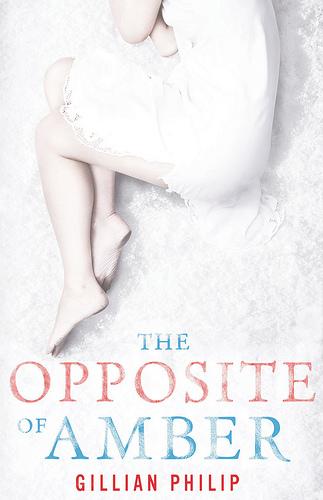
British Books Challenge 2011 - The Opposite of Amber by Gillian Philip
Gillian Philip writes like a dream. Whether she's turning her hand to a fantasy Scotland where exiled Sithe faeries roam the land or, as here, a modern YA crime novel with a challenging subject, she's a winner from any reader's point of view.
I knew how The Opposite of Amber was going to end from the first page of the book. What I didn't know (and Gillian made me sweat and gnaw my nails to find out) was how she was going to get me there. Have no doubts, this is not a novel which pulls its punches. It deals with a very difficult subject indeed--and it does it sensitively and with great compassion. Ruby, the 'heroine' is a great character--memorably described by Gillian as 'spoiled voiceless'. I loved her--she is finely written, a truly rounded creation who reminded me a little of Laurie Halse Anderson's Melinda Sordino in Speak, (about which I have written elsewhere).
But it is her older sister, Jinn, who made me cry with the sad inevitability of her fate. In Jinn, Gillian shows how a series of small wrong-headed decisions made in the name of love can tip a young, well-meaning, caring girl into the kind of low-level 'unprofessional' prostitution which exists on the streets of every town. Yes. Every town. Yours too. Jinn loves Nathan, her no-good drug addict boyfriend (and as an aside here, the way Gillian deals with Ruby's initial innocence and eventual realisation about the paraphernalia of crack cocaine is no less than brilliant). She wants--as many women do in abusive relationships--to save him. To do that, she gives up everything--her home, her relationship with her sister, her job--and eventually, the rights to her own body, leading to her fate at the hands of a killer (and no, I'm not going to tell you who it is or anything more about that at all!). She tries so hard, so desperately to make things right because she is first and foremost a carer--an enabler--although the one person she doesn't look after is herself. Of course, we, as onlookers, know that whatever she does will never be enough to save Nathan--because the only one who can save him is himself. This is a brave, wonderful novel which should not just be read by teenagers. It should be read by everyone who cares about making sure that the many real-life girls like Jinn who find themselves in situations similar to this can get help and support and above all knowledge that they absolutely can have other choices in their lives. Buy it for yourself, buy it for others. A real 5* book.
Now, as always happens on Scribble City Central, Gillian has been kind enough to answer one of my famous and challenging
I knew how The Opposite of Amber was going to end from the first page of the book. What I didn't know (and Gillian made me sweat and gnaw my nails to find out) was how she was going to get me there. Have no doubts, this is not a novel which pulls its punches. It deals with a very difficult subject indeed--and it does it sensitively and with great compassion. Ruby, the 'heroine' is a great character--memorably described by Gillian as 'spoiled voiceless'. I loved her--she is finely written, a truly rounded creation who reminded me a little of Laurie Halse Anderson's Melinda Sordino in Speak, (about which I have written elsewhere).
But it is her older sister, Jinn, who made me cry with the sad inevitability of her fate. In Jinn, Gillian shows how a series of small wrong-headed decisions made in the name of love can tip a young, well-meaning, caring girl into the kind of low-level 'unprofessional' prostitution which exists on the streets of every town. Yes. Every town. Yours too. Jinn loves Nathan, her no-good drug addict boyfriend (and as an aside here, the way Gillian deals with Ruby's initial innocence and eventual realisation about the paraphernalia of crack cocaine is no less than brilliant). She wants--as many women do in abusive relationships--to save him. To do that, she gives up everything--her home, her relationship with her sister, her job--and eventually, the rights to her own body, leading to her fate at the hands of a killer (and no, I'm not going to tell you who it is or anything more about that at all!). She tries so hard, so desperately to make things right because she is first and foremost a carer--an enabler--although the one person she doesn't look after is herself. Of course, we, as onlookers, know that whatever she does will never be enough to save Nathan--because the only one who can save him is himself. This is a brave, wonderful novel which should not just be read by teenagers. It should be read by everyone who cares about making sure that the many real-life girls like Jinn who find themselves in situations similar to this can get help and support and above all knowledge that they absolutely can have other choices in their lives. Buy it for yourself, buy it for others. A real 5* book.
Now, as always happens on Scribble City Central, Gillian has been kind enough to answer one of my famous and challenging
BURNING QUESTIONS
SCC: Where dead bodies are concerned, water plays an important part in both Bad Faith and The Opposite of Amber. Why do you find the combination of running water and corpses such a fascinating and powerful image?" GP: Lucy, this is a googly! I hadn’t thought of it like that before, but now that you mention it...
Maybe it’s partly to do with where I live. I often say I get a lot of my ideas from landscape, and walking around in it, and if there’s one thing Scotland isn’t short of, it’s water. I always did love waterscapes, whether sea or river or loch. I spent huge amounts of my childhood sploshing around in it – lived for 15 years in Aberdeen, which has the most beautiful, vast and desolate beach, and the beach was the default place to go for laughs, games, romance, mooching over a lost love... I suppose that even in Crossing The Line, a crucial scene takes place in water (though not a death, for once!) when Nick goes midnight swimming with Orla – and yes, that was based on one of my own teenage habits...
It’s so fundamental, water, isn’t it? Life and death and this incredible irresistible power. Bits of Bad Faith were inspired by the Moray floods of a few years ago. We live at the top of a hill – lucky us – but the river Lossie is right at the bottom of it, and when the water starts to rise we can see and hear it. It’s spectacular and it’s terrifying. It seemed perfectly natural to put a body in that torrent – which can hide things, and quite unexpectedly reveal them...
But it can do the same when it’s calm and beautiful. Completely peaceful water can conceal things you wouldn’t want to see up close, which is what occurred to me when I was looking for a place to put a body in The Opposite of Amber. There’s a distillery pond I pass every morning on the school run, and it can be choppy and wild or it can be like a sheet of glass. One day I got out of the car for a closer look; the bank kind of slopes back beneath itself, and it struck me that anything could get caught under there...
All this notwithstanding, I must try to be more original! I was starting a new piece of work just yesterday, and I thought “must-not-soak-corpse...” Thanks for a fascinating question, Lucy!
SCC: Thanks for a fascinating answer--and I'm glad I bowled you a googly on this one. Always good to make you consider something you'd never thought about!
Subscribe to:
Posts (Atom)