Friday, 2 March 2012

Fantabulous Fridays A-Z: A FOR AIRAVATA with Sita Brahmachari

Scribble City Central's brand-new mythic alphabet series kicks off in style with prize-winning author Sita Brahmachari giving us the lowdown on a legendary beast from Indian mythology - A for Airavata, the celestial elephant created by Brahma for Indra, Lord of Heaven. 

Sita's first novel, Artichoke Hearts, won the Waterstone's Children's Book Prize last year, and is currently on the Carnegie 2012 longlist. When I read it, I was struck not only by its tender but unflinching depiction of the relationship between a dying grandmother and her grandaughter, but also by the vivid and unique voice of its narrator, Mira Levenson (then 12 years old). 

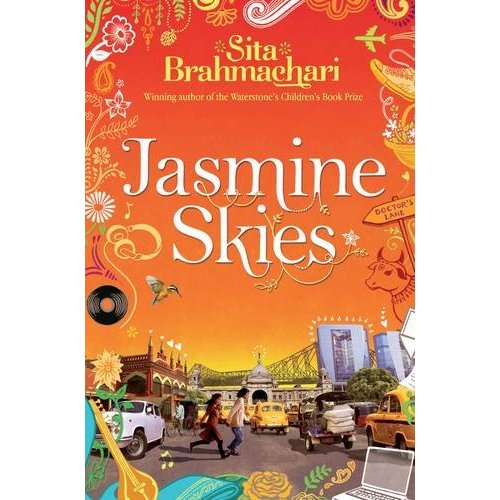
I was therefore delighted to meet Mira again in Sita's new book, Jasmine Skies, which I've been lucky enough to get my hands on early (it's out at the end of this month).  Mira - now two years older - travels to Kolkata to meet her grandfather's family for the first time. But there's a mystery.  Why haven't her mother and her mother's cousin spoken for so many years? What happened to estrange them all that time ago?  Why won't anyone talk to her about it?  Stolen letters throw up questions whose answers seem to lie in the tumbledown family house on Doctor's Lane - where she's not allowed to go.... 

Sometimes second books can be disappointing.  This one most certainly isn't.  In fact, I think it's even better than the first.  Sita's skill lies in making her reader really feel that intimate tug and pull of family relationships as well as the confusing ups and downs of teenage love, and in this book she also shows us facets of India not often seen in children's books.  I don't want to put up any plot spoilers, but I loved small touches like the practical solution the Kolkata mums find to the smelly loos at the dancing gala, which give this book the stamp of true insider realism. Mira is as tenacious and endearing as ever, and the tantalising ending promises what would be (for me) a welcome third volume in the series.  

Anyway, that's quite enough from me.  Here's Sita to give us some insights into her new book and to tell you all about that wondrous white elephant...

A for AIRAVATA
The Celestial Elephant Of The Clouds

SB: The name Airavata comes from the word ‘Iravat’ which means ‘one produced from water.’ As a child I used to remember the elephant’s name by thinking of the component parts ‘air’ and ‘water’ ( the ‘v’ is pronounced with a soft almost ‘w’ sound) . As you will see… the two elements of air and water are central to this elephant’s story.

Like most children, I was fascinated by the animal world and particularly large animals that could not easily be seen, except in zoos or wildlife parks. My youngest daughter is following in my footsteps. Not content with all her small cute cuddly toys, last year she asked Father Christmas for ‘life size cuddly animals’. I tried to persuade her that there might not be much room for these giant beasts to roam freely in our house, but she was not for turning and on Christmas morning Father Christmas dutifully delivered a giraffe (‘Jo’) and an elephant (‘Ellie’) with which she now happily jostles for space in her tiny bedroom. While squeezing around Ellie into her room one evening I asked her what it is about these enormous animals that she loves so much – ‘It’s because they’re bigger than me and you and everyone, but they’re still our friends!’ she answered simply and went on playing.

She’s right. I think it’s the disparity between their size and ours that made me first think of elephants as God-like creatures. In Jasmine Skies fourteen year-old Mira Levenson goes to India. She travels alone and is forced to step out of her family cocoon and experience a much wider world. As she faces challenging situations she finds it comforting to think back to when she was much younger. As a small child Mira remembers looking over her grandfather’s shoulders as he translated stories from the great Hindu tales of the Ramayana and the Mahabharata. Mira explains that as he read to her she only half heard his voice because her artist’s imagination was too busy conjuring images in her mind’s eye. In Jasmine Skies I don’t describe which pictures Mira is captivated by but I can tell you about the one that most inspired me as a child – it was the beautiful white elephant of the clouds, Airavata, with his five heads, tusks like a mountain range, and many trunks.

To explain to you why Airavata continues to live in my imagination I should start by sharing a few of my own childhood and adult meetings with elephants… though none of the elephants I’ve come across have ever been white!

An early childhood memory of a family holiday in India is of walking down a road alongside an elephant bedecked in garlands, painted and bejeweled, with a carriage on its back carrying a bride and groom to their wedding ceremony. They were accompanied by a procession of musicians, dancers and wedding guests. Romantic or what?!

As an adult I visited an elephant sanctuary in Sri-Lanka and was moved by the close relationship between the elephant keepers – the Mahouts – as they cared for, washed, bathed and splashed in the water with their ‘own’ special elephants. It was not until I saw a family of elephants playing in their natural element – water – that I began to really appreciate what noble and extraordinary creatures they are. Seeing how tiny their keepers are, some of them as young as thirteen, made me realise that it is the elephants who decide to be gentle with their human keepers. They are in charge.

Some years after visiting the elephant sanctuary I had a call from the parents of a school friend to say that she had been on a safari in Africa and had been trampled by a rogue elephant. She survived but the way she spoke about the experience afterwards was as if she had collided with an ancient God-like force. It is rare for an elephant to attack a human in this way, but I think that our fascination with elephants in life and mythology is because of this combination of potential power and gentleness (despite the enormous size of their feet, an elephant’s footfall can hardly be heard).

Because of these experiences the story of Airavata in all his power seems to speak to me today even more strongly than it did when I was a child. I’ll try to re-tell this story in the way that it was told to me. I’m not sure how much is drawn from memory of childhood tales, or illustrations, and what I might have added along the way, but I think that’s the power of all great myths; that they can live with us from childhood into adulthood and feed our imagination. I hope this myth fills your mind with pictures as it has mine… and Mira’s!

Even Gods need friends…
The day came when the noble Indra, the Lord of Heaven, needed a powerful animal to help him fight his battles, to create rain in drought and well … to be his friend! Even Gods need friends. So Indra journeyed to the great creator Brahma and asked if he could dream up such an animal. Brahma churned the milk oceans and after stirring the sea he lifted from the waves an enormous egg. Imagine this! When the shell cracked open it was not birds that emerged but a herd of baby elephants with wings! Among their number was only one bright white elephant and that was Airavata. As they grew, the elephants spent their time careering through the sky and sometimes small birds would even take lifts on their grey mounded backs. One day, while messing around, the herd crash-landed into a tree – as teenage elephants tend to do – and nearly flattened a holy man who was sitting cross-legged praying in the shade of the branches. The holy man lost his rag, cursed the wayward elephants and stripped them of their wings. From that day on the poor elephants never flew again. Just imagine how different the skies would look if elephants could fly!
No matter how much Airavata loved to hang out with the herd he knew that one day he was destined for greatness. So it was that when Airavata was fully grown he became the most loyal companion and protector of Lord Indra. According to the Mahabharata, in the battle field Airavata ‘showered weapons on enemies like lightening charged clouds driven by the winds.’ But Indra knew in his heart that Airavata was more than a war elephant. He was so gentle and playful, especially when bathing in the rivers. When Indra looked into Airavata’s great dark eyes, he glimpsed the deep wisdom that lay within his powerful friend.

The dry weather came, as it always did, and it felt like the rain would never fall on the earth again. If you have not experienced life without water, never walked for miles to a well in the scorching heat of the sun, then you cannot know how terrible is the suffering that comes with drought. So it was that Indra looked on his people with great sorrow. The earth was parched, mouths were parched, and nothing grew on the land. Soon Indra knew that bellies would be empty, a sight that he could not stand to see and this is why wise Indra had asked Brahma for a companion that could be so much more than a beast of war.

The day came when the beautiful Airavata, walking in his majestic lilting step, arrived at his favourite place by the river to bathe, but he found it dry – dry as dust, dry as bone. Then Airavara raised his huge trunk to the sky and roared, a roar so full of sadness it is said that his master, Indra, the Lord of Heaven himself, was brought to tears. These tears spurred Indra to bring the suffering of his people to an end. So it was that Indra called on Airavata to reach his trunks deep into the bowels of the earth and draw up water from the ancient underground springs. When Airavata’s heads finally re-emerged Indra ordered him to trumpet the water up into the sky to form rain clouds. Thick elephant bellied clouds gathered in the sky as Airavata sent up a deafening triumphant roar that ricoched through the universe. The great elephant reared up on his hind legs and pierced the clouds with his forceful tusks. Celestial rain poured down upon the earth and the rivers filled once more with water.

Born of an egg, with the strength and power to fight, befriend mankind and make rain in times of drought, it is no surprise that the beautiful Airavata is one of the most sacred elephants in world mythology. He truly deserves his place of honour resting on the points of the Earth’s compass, supporting the deities who carry the weight of the entire world on their shoulders.

In Jasmine Skies Mira is often moved to tears by the poverty she sees around her. The poverty and suffering caused through drought and flood in many places in the world, including India, Bangladesh, Pakistan and Africa, is appalling. If I were to tell a story written in a landscape of drought or flood Airavata would definitely make an appearance because his presence would always bring hope.

I wonder if Terry Pratchett drew some of his inspiration from the mythology around Airavata when he wrote the amazing Discworld series. The image of the elephants holding up the disc-shaped world, with the waterfall flowing over the edges, is such a potent one.

There are moments in Jasmine Skies when Mira realizes how small and insignificant she is in the vast universe. Mythology is a way that humans have always attempted to make sense of our world. Many myths are born from the human search to understand the wonders of nature, in all its power, frightening force and unpredictability. For me, the epic scale of nature’s wonders is celebrated in Airavata – the beautiful celestial elephant of the clouds who is, as my daughter said, ‘bigger than you, me and everyone.’

SCC: That was fascinating, Sita, and I've learned such a lot I didn't know.  What a wonderful story - thank you so much for getting the Fantabulous Fridays A-Z off to such a great start. My Lovely Blog Readers can join in the discussion about this post on Twitter, using our special #FantabFri hashtag.  Sita and I would love to hear from you!

Next week: B for Basilisk with N. M. Browne, author of Wolf Blood.

Friday, 24 February 2012

Announcing 'The Fantabulous Fridays A-Z' on Scribble City Central


THE FANTABULOUS FRIDAYS A - Z IS  COMING TO SCRIBBLE CITY CENTRAL NEXT WEEK!

I've been itching to make that announcement since the beginning of the year - and now, at last, I can.

Q: But what on earth IS The Fantabulous Fridays A - Z?

A: Following on from the success of 2010's Mythic Friday Interviews, 43 Fantastically Fabulous Children's and YA authors will be visiting Scribble City Central (one every Friday from now till the end of December), to talk about a favourite mythical beast or being, in alphabetical order from A for Airavata right through to Z for Zephyros. When it's finished, there'll be an amazing online mythological reference resource full of interesting titbits of wisdom to dip into - forever. 

I can't WAIT to introduce all those lovely writers and their fascinatingly beastly choices to you - there are some very special surprises in store, as well as a few prizes and goodies to win. So keep an eye out here and on Twitter at #FantabFri for the first in the series next week, coming from award-winning novelist Sita Brahmachari

See you then!

Monday, 20 February 2012

The Scribble City Interview: Celia Rees on 'This is Not Forgiveness'

Celia Rees is Scribble City Central's first guest author of 2012, and I'm delighted that she's here today, answering my many 

BURNING QUESTIONS

about her wonderful new YA thriller, This Is Not Forgiveness. I read TINF a few weeks ago, and it is  a book which dragged me into its pages, held me captive and spat me out the other end, exhausted, enthused and enthralled.  It also made me want to ask Celia a good many things, as I'm always fascinated to see how other writers' thought processes work, and how they deal with difficult subject matter.  Luckily for you, Lovely Readers, Celia agreed to be interviewed, so without further ado, I'll hand you over to her.
Copyright Helen Giles (PhotoWitch)
SCC: Melvin Burgess calls your book ‘lyrical and gritty’, Patrick Ness says you have ‘ventured into new territory and returned with explosives’. What drove you on to write this book – to depart from everything you had done recently and set out in this very different direction for your work?
CR: Whatever I write, I’m always impelled by an idea. Before I wrote Witch Child, I’d never written a historical novel. I was daunted by the amount of research I’d have to do, but I knew I had to write it. After Witch Child, I wrote more historical fiction, and I could have gone on doing that, but then I had the idea for This Is Not Forgiveness. I was watching François Truffaut’s Jules et Jim. The film (and the book on which it is based) is about two young men who are close friends and their joint obsession with an extraordinary young woman. It is set before and after the First World War, but it has a timeless quality and I suddenly thought, you could make this now. The idea linked with other bits of ideas I’d had over the years and it wouldn’t go away. It would be a departure and a challenge, but I like challenges, they keep my interest and my writing fresh. Also, my first novels were contemporary thrillers for teenagers and I liked the idea of going back to my roots.

SCC: Your three main characters are all beautifully observed, and they have in common this: that they are all observers of others. You also make use of mirrors a lot in the book, seemingly as a way of stripping layers away to get at the truth. Are you, like many writers, most comfortable as an observer yourself? Why do you think that is, and what are your favourite methods of covert observation?
CR:Yes, I am an observer, always have been. Wherever I am, I’m watching, thinking, speculating. It becomes second nature. I keep notebooks handy, but often I just squirrel observations and reflections away in my head. They can be there for years only to pop back up again when I’m writing. To do this, one needs a certain amount of anonymity. I think one of the problems writers face now is being forced into participation, by the pressure to appear and make use of social media.

SCC: “Death is the end of the road – the ultimate destination where you can be alone.” Caro, Rob and Jamie all have a parent who has committed suicide, and this has, whether knowingly or unknowingly affected each of their lives. Was it important to you to show the repercussions that a parent’s actions can have down the generations?
CR:The death of a parent, in whatever circumstances, is very traumatic. My father died when I was twelve. He died very suddenly and the shock was so great, and my mother’s grief so profound, that no-one would talk about his death. He just disappeared from our lives. This obviously had a deep and profound affect on me and his death was from natural causes. I can only speculate about how deeply affecting a parent’s death by suicide would be.

SCC: "Medals cast deep shadows...I’m broke beyone anyone’s fixing." You clearly did a lot of research on soldiers, PTSD, and how combat troops (especially wounded ones) deal with being back on civvie street. Who did you talk to to get that amazing ring of truth into Rob’s character, and how did it affect you?
CR: I read a great deal about the effects of war on those who do the fighting, not just in the current war in Afghanistan and the recent conflict in Iraq, but also in the First and Second World Wars and in Vietnam. There are plenty of first hand accounts, both of fighting and the affects it has on combatants. I also watched films, like Kathryn Bigelow’s The Hurt Locker, series like Generation Kill and viewed Soldier Vision’, video footage put up on the internet by soldiers on active service. I spoke to members of the armed forces who were on active service, but I did not go in for lengthy, extensive interviews. I felt that would be intrusive, inappropriate, somehow.

SCC: What I particularly like about this book is that it shows normal teenagers behaving and talking as they all do in 2012 – it’s refreshingly real. You’ve got right inside their heads, but it’s a brave (some would say risky) thing to do to portray them in all their unvarnished glory. Did you find it immensely freeing to let them swear, take drugs, have sex and drink? Or was it quite scary to write?
CR: Anyone who writes for teenagers knows that there is a kind of covert censorship about what one can and cannot write. Decisions have to be made, especially about sex, swearing, drugs and alcohol (violence seems to cause less offence) and this has NOTHING to do with how teenagers really behave, or their real lives. As I said in answer to Question 1, this book was going to be a departure. If I was going to do it, I was going to show things as they really are. Teenagers swear, have sex, get trashed. I did not feel in the mood to compromise.

SCC: “Gossip creates its own reality. I am a slag because everyone says I am,” says Caro. Do you think this is a modern effect of the celebrity magazine-fuelled world we live in, or has it always been like that? Do you think that gossip like this is another insidious form of bullying?
CR: The double standard that applies to young women’s sexual behaviour has always been there. It may have been exacerbated by modern celebrity magazine culture and the tabloids’ salacious hypocrisy but modern means of communication, texting, social networking, certainly spread the poison faster than whispers in the classroom. And, of course, it is a virulent and vicious form of bullying.

SCC: Your plot is all too scarily believable, but, of course, those exact right ingredients for your explosive mix would have to be in place for this to happen in real life, (which is hopefully unlikely). However, do you think that we, as a society, are in real danger of creating a situation like this, by making our young people powerless, disenfranchised and demotivated to engage with the world?
CR:
When I first thought of the idea, Caro’s interest in radical politics was questioned, then students were on the streets of London demonstrating, with a fringe taking things to violent extremes, and it did not look quite so unlikely any more. Waves of this kind of political unrest go back through recent history (Caro’s heroes are the Baader Meinhof Red Army Faction) to the nineteenth century and earlier. Any society ignores this kind of dissatisfaction and unrest at its peril. Just look what is happening in Greece and Syria right now.

SCC: “Occult paraphernalia, leached of their power, become mere knick-knacks.” It’s strange to find tarot cards, runes and a planchette in a story of such practical gritty realism. While Caro seems to dismiss the power they once had over her, she still reaches for meaning within them. Have you ever succumbed to the lure of fortune tellers and futurecasters? Are you superstitious, and if not, why do you think that is?
CR: I just saw it as goth-emo a phase she went through, but being Caro, she went into it pretty thoroughly and some of it stuck. I have more than a passing acquaintance with the occult, having written books that dealt with the supernatural in its different manifestations, from my early Point Horror Unleashed and Hodder titles, to Witch Child and The Stone Testament, so it was easy to fold this in to the mix. It doesn’t mean I believe myself, but I will admit to a certain fascination with it. What interests me more is why people want to believe.

SCC: Caro’s imaginary ‘kill list’ in Rendez, and Rob’s similar one from the multistorey at the end bring the book full circle. Was that a deliberate linkage – another kind of mirroring?
CR: It wasn’t conscious, but then lots of things aren’t. You write something, then you notice a certain symmetry. It is as though some unconscious part of your mind is at work. I like it when this happens. It gives the work strength, a veracity that is greater than anything you planned.

SCC: I always worry about the music I mention in a book, fearing it will date it. Was that a concern for you, or did you want TINF to be marked as being of this particular time? Did you have a special playlist for the book, and if not, what did you listen to while writing it?

I think that the book can’t help but be placed in a particular time, because of the events that influence the action. I make compilations and playlists for all my books, whether its 18th century seafaring songs for Pirates!, folk ballads and The Beggars’ Opera for Sovay or Elizabethan songs for The Fool’s Girl. For This Is Not Forgiveness, I had a mix of music. Some tracks conjured mood and character; some provided music for the characters themselves to listen to; some did both. Some were my choices; others were suggested by young persons of my acquaintance. Judge for yourself, which are which.

Celia's Playlist (in no particular order):

Vaccines – Wreckin’ Bar; Post Break Up Sex

Cold War Kids – Sensitive Kid; Broken Open

Friendly Fires – True Love; Blue Cassette

Crystal Castles – Vanished

Arcade Fire – The Suburbs; We Used To Wait

Libertines – Don’t Look Back Into The Sun; Can’t Stand Me Now; Time For Heroes
The Smiths – There’s a Light That Never Goes Out; Please, Please, Please, Let Me Get What I Want

Stone Roses – Waterfall
Bob Dylan – Billy #4 - Soundtrack: Pat Garrett and Billy The Kid

Van Morrison – Cyprus Avenue; Madame George

Alison Krauss – The Scarlet Tide
The Cardigans – My Favourite Game

Mumford & Sons – Winter Winds; Little Lion Man

Sex Pistols - Anarchy In The U.K.
The Specials - Friday Night, Saturday Morning

The Undertones - Teenage Kicks

Noah And The Whale – 5 Years Time

Wheetus - Teenage Dirtbag

Depeche Mode – In Your Room

Brecht/Weill – Pirate Jenny – The Threepenny Opera

Kraftwerk

And…

The Boom Town Rats – I Don’t Like Mondays

This Is Not Forgiveness has its very own micro site:
http://www.urflixstar.com and an ‘official’ playlist at http://www.urflixstar.com/tinf-playlist
There is also a trailer, if any of your readers are wondering what on earth we are talking about: http://www.youtube.com/watch?v=vTD1w7nKYD0&feature=player_embedded

SCC: In 35 chapters you have only 8 chapter head quotes, ranging from Peter Sansom through Brecht and Weill’s Threepenny Opera to Emma Goldman. Are you a serendipitous finder of ‘the right quote at the right moment’, or is it something you research and think about very carefully?
CR: The book is written in Voice, from different points of view. Jamie tells the story, Rob makes podcasts (you can see an extract at: http://youtu.be/akiiy8io968 ) and Caro keeps a notebook. The quotations head up her chapters. I decided to do this because she seemed like the kind of girl who choose pretentious quotations and write them down in her notebooks as statements. I chose them carefully to give an insight into her thinking; the range and diversity of her interests; her depth and her shallowness. The Peter Sansom quotation is more serendipitous. I was at a poetry reading and he read his poem, My Brother’s Vespa. I liked it because my brother had a Vespa, and then I thought the last two lines would be perfect for This is Not Forgiveness. I asked him if I could use them and he said, ‘yes’.

SCC: Finally, if you had a wish for this book, what would it be?
CR:
One always has hopes, but it would tempt fate to say what those hopes might be and, yes, I am superstitious!

SCC: Those were marvellous and enlightening answers, Celia. Thank you for being so honest, and for giving us all a peek inside your head. Honestly, Lovely Readers - go and buy this book now - today.  It's an absolute must-read winner, and I predict it'll be on every 2012 prize list!

Find out more about Celia here:
Celia Rees Website
Celia on Twitter
Celia Rees Official Facebook Fan Page

Monday, 30 January 2012

Captain Beastlie is Born

When you see the first pictures for one of your stories, it's always an amazing moment.  One minute you have words on a page, and the next, someone else has brought them to a life in full colour.  This is the moment, for me, that a book is really born. I've been itching to talk about Captain Beastlie for ages - he's been living in my head for years, every stinking, rotten, grubby inch of him.  I've no idea where he came from - probably the thwarted pirate inside me.  But of course, until he was properly announced by his lovely publisher, I couldn't.  Anyway, he's now up on the Nosy Crow website in all his full glory, as imagined by amazing artist Chris Mould, with whom it is a privilege to be working.  When I first saw his roughs last week, I did a small jig of joy.  Now I've seen the first colour picture, I'm even more cock-a-whoop.  Chris has imagined Captain B better than I ever could, and put in some extra specially revolting touches as well.  Even though this book isn't out till April 2013, I'm already mega-excited about it.  If you'd like to read more about my grimsome, gruesome pirate, the link is

HERE
    

Tuesday, 17 January 2012

Science Matters....

Today, I'm over at An Awfully Big Adventure (the writers' blog cooperative I belong to), talking about my newly fledged fascination with science (as well as my appalling ignorance of it), and how it all ties in with writing. A little soupCERN of Higgs-Boson, anyone?

Tuesday, 10 January 2012

Scribble City Central's Predictions for the Writing Year - 2012

Once again, Happy New Year to my Lovely Blog Readers.  As ever, I've been gazing into my crystal ball on your behalf to bring you my predictions for the coming year.  I did a pretty good job of it last year, though I say it myself.  If you're doubtful about my veracity, you can read what I forecast for 2011 HERE.

So what's new for 2012, apart from the UK Olympics, the inexorable rise of China, the continuing economic decline...and the coming of Doomsday with the end of the Mayan Long Calendar on 21st December? Well, here goes - this is what I think will happen in the next 12 months.

Writing and Politics
The Government doesn't like writers much. We're too fond of pointing out the uncomfortable truth to people like Ed Vaizey and Jeremy Hunt. PLR dropped last year, and the very efficient department administering it has become a victim of the cuts.  I predict a further drop and less efficiency. Despite brave and tenacious legal battles, libraries are dying like flies, and the situation continues to worsen for reading and readers everywhere, with both independents and chains feeling the chill winds of closure.  It's not going to get any better this year either - there'll be more shock shutdowns everywhere, and I'm certain that the demise of the euro (yes, I'm definitely predicting that) will affect us all.  However, if we get enough people on the streets on National Libraries Day on February 4th, maybe we can turn things round for the libraries at least. Put the date in your diary, please! (Unfortunately, I also predict that library campaigner Alan Gibbons will not be getting an OBE in 2012 - though he damn well should). School budgets are massively down too, so I'm certain that author visit bookings will become rarer than hens' teeth. I think that writers will have to become much more political this year. We can't just stand on the sidelines and watch - we have to shout even more loudly at the people who are depriving children of their reading potential. We must harness our anger and focus it effectively.

Writing and Social Media:
Facebook is on a downward trend in my opinion (too many changes), and Twitter will increasingly become the social media tool of choice for most writers - especially for YA authors, as more and more teens are joining up, and can be reached directly. But beware! It's not a direct selling tool for books. More authors will also join the Linked In bandwagon, though most will be bewildered by what it actually achieves for writers (not a lot, currently). YouTube will become bigger than ever, with a book trailer becoming the norm and not the exception (actually, that's already happened). As publishers' budgets are stripped still further, authors are once again going to have to cooperate in 'putting themselves out there' via social media in order to promote and sell books (even more so than previously). If you haven't yet built a social media presence, for goodness' sake do it now - the future of books is definitely on the internet, however much we all love the paper versions.  Writers themselves will become more powerful as a group - social media has proved revolutionary in this respect already - and we will all be grateful for the support of our peers in the difficult times ahead. This will possibly make publishers increasingly nervous! Writers and artists talking to one another? Whatever next?

Writing and Technology:
Last year I said that 'this will be the year when e-books rock the public perception of reading'. Er, was I right?  I think so! With Kindle sales through the roof, and e-books overtaking print books by a considerable margin, technology is careering ahead, sometimes leaving publishers behind and floundering in the tailwind of its rise. Many more already established authors will learn to 'Kindle' their books this year - some self-publishing out of frustration and some providing 'add-ons' to existing traditionally published work in the form of stories or novellas.  The buzzwords for 2012 will be 'added content'.  Despite the many 'blog tours' out there for book promotion, I'm predicting a backlash against them from unpaid book bloggers fed up with the inexorable timetable, which requires them to read and comment on books at a frantic rate. Authors will increasingly become available for Skype school visits, which will open up a global audience for their work, thus making it even more important to have work available in e-formats. The good news is that teens (GenY) are reading on their smartphones. The technology for moving picture books to e-books will race ahead still further, becoming cheaper and easier to programme, and small children will be able to interact with their favourite characters as a matter of course via apps, and busy parents will turn to iPads and tablets even more as readers of bedtime stories.  Pirating is already a real problem for authors, and that's only going to get worse.  Copyright theft should be addressed urgently this year, but effective measures are unlikely to come quickly. I also predict more approaches from foreign e-packagers (Korea, China, the USA) looking for material for those of us who have out-of-print picture books lying about doing nothing.

Writing and Publisher Deals:
Oh dear!  I don't want to be the Prophet of Doom here...but it's not going to be easy to get a contract for anyone.  Advances, as I predicted for 2011, are down hugely, and the art of the good synopsis will be increasingly essential.  It will be very unlikely that first (or even third) time authors will get a deal for anything less than a full manuscript, which means time and energy spent with no assurance of a positive outcome.  Paranormal will still be hot in YA, but it'll have to have a very different spin to get published at all.  History is going to be hard to sell for all but a few, and dystopia is still there, but again, it will have to have real quality to be bought.  Frankfurt was good in 2011, and I'm predicting a frantic selling Bologna for those lucky ones with a deal.  London Book Fair too will be busy, and it is shaping up to be much more 'author friendly' for children's writers especially this year, with lots of interesting seminars going on.  It's not all bad news for writers, though, with new independent publishers like Nosy Crow and Hot Key Books popping up and commissioning.  There are also more competitions out there for new and unpublished writers, which can be a route to publication.  I'd say don't despair, but be realistic this year. Don't give up - it is going to get better eventually (though I won't say soon), and the Americans are buying again at last. That has to be good news!

Writing and...me:
Quite honestly, though I wasn't saying so, I was bricking it this time last year.  I had no contracts in view, and the view wasn't all that rosy.  However, my 2011 was better than I could ever have dreamed.  I've got back into the picture book market with two new books coming from Nosy Crow and Bloomsbury in 2013, about which I'm delighted, and Lovely Agent has sold a middle-grade mythological series of novels to the USA, also for 2013.  So it was a good year - and I've finished my YA novel, about which I hope to have good news soon.  So although 2012 brings no publication dates, I have some deadlines to stick to (three contracted books to write), more picture books to come up with, and a lot of fingers in bookish pies (about which more in due course).  I'm also taking part in the brand new Chipping Norton Literary Festival, planning for the second ABBAlitfest, doing a few school visits and, most exciting of all, going to Bologna Book Fair for the first time ever in March.  It's going to be an amazing year of writing for me, and I'll be keeping you all posted either here or on Twitter about any developments. 

Once again thanks for sticking with me, Lovely Blog Readers - I am so grateful to you all for your comments and participation here, and I promise there'll be a Big Blog Announcement about a brand new series of author interviews on Scribble City Central very soon. Watch this space - I'm plotting and planning for your delight even as I write this.  Do tell me your own writing predictions, hopes and dreams for 2012 - I'd love to hear from you. 

Thursday, 5 January 2012

New Look 2012 Scribble City Central goes Live!

I am excited to announce that the redesign of Scribble City Central is now complete, thanks to the amazing Lori Lawson of Imagination Blog Designs. Do let me know what you think of it!

In other news, there'll be plenty of fabulously fantastical writing-related stuff coming up in 2012, including a brand new series of author interviews, so watch this space.

Happy New Year to you all, and I look forward to seeing you back here soon!
 
Blog Design by Imagination Designs all images from the Before the First Snow kit by Lorie Davison