Friday, 10 August 2012

FANTABULOUS FRIDAYS A-Z: K FOR KELPIE WITH HOLLY BLACK


Scribble City Central's twenty-fourth Fantabulous Friday comes from Holly Black, New York Times bestselling author of the Modern Faerie Tales series, Tithe, Valiant and Ironside. I loved all three Modern Faerie Tales, which mix life in modern-day America with the darker world of the Seelie Court.

There's a bite and a twist to Holly's writing which I find particularly appealing.   I also very much like the way she digs deep under the surface of characters who on the face of it should be unattractive, and makes them sympathetic.  I particularly like Ravus the troll for just this reason.

Holly's latest series, White Cat, Red Glove and the just-published Black Heart follow the fortunes of Cassel Sharp, a teenage Curseworker, and take her in a different direction entirely.  The world of the Curseworkers is an underworld of murder and magic mixed with life at a preppy school in Manhattan.  It's a heady brew of love and moral dilemmas, and it's GOOD.  I've just finished Black Heart, and I whipped through it at such a rate that the pages turned in a blur of speed.  It was that exciting.  Sometimes when you come to the end of a series, the ending makes you, as a reader, go 'Meh'.  Not this one.  I'm not putting up any spoilers by telling you that I wanted to throw my hat in the air and go 'Wheee!" If you haven't read Holly, I'd highly recommend that you do, and here she is to tell you about:


K for Kelpie
Scottish Shapeshifter


HB: The kelpie is a Scottish water horse that haunts streams, rivers and lochs, luring lonely travelers to their deaths. The kelpie takes on the form of an ink-black horse or a dark-eyed human boy, but always keeps some aspect of its supernatural self, often waterweeds tangled in his hair. They’re said to delight in storms and to make a sound much like thunder. Should you see a kelpie, never be enticed to ride on its back, because the kelpie is compelled to rush into the water and drown its rider.

Sir Walter Scott put a kelpie into his “From the Abbot” poem:
“From haunted spring to grassy ring
Troop goblin, elf, and fairy ;
And the kelpie must flit from the black bog-pit,
And the brownie must not tarry ;
To Limbo Lake,
Their way to take,
With scarce the pith to flee.
Sing hay-trix, trim-go-trix,
Under the greenwood tree.”

Not all accounts of kelpies are terrible. There are also accounts of kelpies coming to the aid of the lost, of bearing sacks of meal and other burdens. There’s even a way to tame a kelpie – by stealing its bridle. Bridled kelpies make very strong and clever horses, but if they find their bridle again, they will (quite rightly) seek revenge.

The first time I read about the kelpie was in Faeries, described and illustrated by Alan Lee and Brian Froud. There is an absolutely gorgeous drawing of a water horse rising from a lake, simultaneously terrifying and compelling. It stayed in my mind and that picture, along with the rest of the book, fueled my desire to read other folklore. If you’d like to see some more images from the book, check out the World of Froud website.

The thing that fascinates me about kelpies is part of what fascinates me about faeries in general – the fact that they are other than human. They are capricious and dangerous, with a moral system unlike ours. The things they count as high crimes aren’t human things and their what they count as punishment is always some form of poetic justice. Their rewards are, sometimes, just as barbed.

I put a kelpie in my first novel, Tithe. Here’s a tiny excerpt from where the protagonist, Kaye, calls him from the water:

“Its color was not so much black, but an emerald so deep that it looked black. And the nacreous eyes were gleaming like pearls. Still, when it regarded Kaye, she was forced to think of the research Corny had done. That was chilling enough.

“The kelpie strode onto the shore and shook its great mane, spraying her and Corny with glittering droplets of swamp water. Kaye held up her hands, but it hardly helped.”

And then:

“The creature looked at Kaye and shifted, and where it had been stood a young man, nude and still dripping, hair tangled with rushes.”

In Tithe, the kelpie is charming and lethal, a murderer who’s fascinated with broken things. He’s a perfect character to warn us what the world would be like if faeries were free to charm humans without any leaders to check their worst impulses. He’s also a great character to remind us of all the things we like about faeries and maybe shouldn’t.

SCC: "All the things we like about faeries and maybe shouldn't".  Yes, that rings a bell, Holly!  I think that's very much part of the fascination for me, and I am sure others here will agree. Thank you so much for visiting, and I hope this post brings many more readers your way.

You can find all of Holly Black's books mentioned in this piece by clicking the link HERE.

Next week: M.G. Harris, author of The Joshua Files kicks off a Mexican wave with K for Kukulkan.  Hasta la vista, amigos!

Friday, 3 August 2012

FANTABULOUS FRIDAYS A-Z: J FOR JORMUNGAND WITH KEVIN CROSSLEY-HOLLAND


For Scribble City Central's twenty-third Fantabulous Friday, I am delighted to welcome one of my favourite authors of all time, Kevin Crossley-Holland. I've known Kevin for many years, and was lucky enough to be part of the editorial team working on his master oeuvre, British Folk Tales, (or as it is now, The Magic Lands). He has won more awards than you can shake a stick at, including the Carnegie Medal, and has just taken on the important post of President of the School Library Association at this crucial time for the health and salvation of all libraries in the UK.

All that aside, Kevin is, for me, THE master of British and Norse myth and legend.  His writing combines a deep love and understanding of the way story and words combine to make an irresistible whole, with a passion for the kind of meticulous scholarship and research which makes a book sing with authenticity.  He has brought all of these talents to his latest work, The Viking Sagas.  The first of these, Bracelet of Bones, was published last year, and the second, Scramasax, comes out at the end of this month from Quercus.  I've been privileged to read an early copy of the latter, and I can tell you that once started it was unputdownable.  The Viking Sagas follow Solveig, daughter of Halfdan on her journey from her home in Trondheim through the Baltic States and finally (at the end of Bracelet of Bones), to Miklagard, which we now call Istanbul.  Scramasax takes Solveig and the reader further still - though I won't put up any plot spoilers. Both books are full of excitement, danger and tremendous storytelling skills.


It will not, I think, spoil anything to tell you that Kevin's own journey towards these books started with the discovery of Viking runes reading 'Halfdan' carved on a high balustrade in Hagia Sophia. By such things are a writer's inspiration and imagination fed.  The two sagas which evolved from this small but serendipitous discovery are written with the eye of a poet and the language of a bard.  Solveig is a compellingly attractive character, brave, determined - herself a creator - but what I liked most of all about her was her questioning mind.  She does not accept that things are the way they are, nor that she cannot change them, and in Scramasax particularly this questioning and thoughtful attitude comes through very strongly.  Her clear-eyed appraisal of Harald Hardrada's character is a perfectly judged piece of writing - and her reactions to seeing the bloodier side of war for the first time are both moving and viscerally poignant. I think she will speak to teenage readers in a way that they will recognise and relate to emotionally, even though she comes from a time so far away from our modern age.

Equally important for a writer of historical novels is the ability to envision 'how it would have been', to make those dry, dusty nuggets of research come to life.  As always with writing of this sort, the devil is in the detail, and Kevin does not fail here either.  His accurate description of the way it would feel to be in a dromon during a squall of the island of Chios made me feel as seasick and scared as if I'd been in the hold with Solveig and the horses myself - there are many such moments of 'drawing in', throughout these novels - small perfect touches which bring the books to vivid life.

Another thread woven through both books is that of religious myth, (there's a very subtle nod towards the great Snorri Sturluson, who wrote the Edda and the Heimskringla over a century after these books were set). The delicate tensions and balances between Norse, Christian and Muslim beliefs in that period are deftly handled, but it's the Norse stories of the gods which catch and hold the reader's imagination.  There's no one better than Kevin at recreating those particular myths and it is with great pleasure therefore that I hand you over to him now to tell you about

JORMUNGAND
Monstrous Serpent of Midgard


KCH: Who or what could be more ghastly than the three children of the Norse trickster Loki and his giant-mistress?

The first is the huge wolf Fenrir who can only be bound with magic ribbon made by the dwarfs from six things: the sound a cat makes when it walks, a woman’s beard, the roots of a mountain, a bear’s sinews, the breath of a fish and a bird’s spittle.

The youngest is Hel.  Above the waist she’s a beautiful pink woman, and below the waist a greenish-black corpse. Her bed is called Sick Bed and the curtains around it Glimmering Misfortune.  She rules the world of the dead.

The middle child is an absolutely terrifying serpent called Jormungand – an Old Norse word meaning ‘huge monster’.  Odin, father of the gods, takes one look at him and hurls him down from his kingdom, Asgard.  He drops him into the churning ocean surrounding Midgard (Middle Earth), and there the serpent grows thicker, and more gristly, and longer and longer, until he’s  able to encircle the whole earth and bite on his own tail.

Jormungand and Thor, god of the sky and of law and order, are deadly enemies, and two of the racy, ice-bright myths tell of their encounters. The third and last one is still in the future.

First, Thor goes fishing.  He uses for bait the head of Heaven Bellower, a black ox, and Jormungand takes it.  Thor hauls him over the gunwale of his boat and whacks him on the head with his hammer, but the serpent tears himself free, and sinks back to the bottom of the sea.

When Thor travels to the world of the giants and wrestles there with a grey cat, he has no idea that he is actually wrestling with  Jormungand in disguise.  ‘When you made him lift that paw,’ the Giant-King later tells Thor, ‘Jormungand all but grazed his back on the sky’.

In a terrible battle before the end of the world, gods and humans and giants and dwarfs and monsters will fight, and Loki will join in, sailing in a boat made of dead men’s fingernails and toenails. That’s when the Midgard Serpent and Thor will come to grips for a third time. Gaping Jormungand will slither up on to dry land, spewing venom…

Ah!  What glorious stories these are, the myths told by the Vikings and first written down by a 13th-century Icelander, Snorri Sturluson. Lying on my bunk bed,  I heard some of them as a boy from my father; later,I read retellings of them; and then, after camping for part of one summer in Iceland with my two young son, I spent four years making my own versions (The Penguin Book of Norse Myths).

I don’t really like snakes or sea-snakes.  They make my stomach loop the loop.  I don’t even like eels (except to eat). And I don’t like evil Jormungand – not one bit. But somehow I knew about him long before I heard stories about him or learned his name. I met him in my dreams. I met him at Whipsnade Zoo.  I met him in the stories of 'The Lambton Worm' and ‘The Laidly Worm of Spindleston Heugh’ (in Old English, wyrm means dragon or serpent) and in the great poem, Beowulf.  I met him in the Garden of Eden.  He was always there, and he always will be, for as long as you and I live. 

SCC:   Thank you, Kevin, and I hope this will be the first of many future visits to Scribble City Central.  As always, you have fired imagination and my mind is filled with pictures - I'm sure all my lovely blog readers will feel the same way.

 If you'd like to read Kevin's books, you can buy them by clicking HERE. 

Next week:  Holly Black, New York Times bestselling author of Modern Faerie Tales and The Curse Workers series, talks about K for Kelpie.  See you then.


Friday, 27 July 2012

FANTABULOUS FRIDAYS A-Z: J FOR JABBERWOCK WITH ELLEN RENNER


Scribble City Central's twenty-second Fantabulous Friday creature is brought to us by Ellen Renner.  When I read Ellen's debut novel, Castle of Shadows, I knew a powerful new voice had joined the world of children's literature, and its sequel, City of Thieves confirmed me in that belief. Ellen's slightly skewed historical world has flavours of both Aiken and Peake, with a touch of steampunkery, but is entirely her own, and her main characters are people you come to care about deeply by the end of both books.  Now I am terribly excited to hear that Ellen has embarked on a new project.  Called Tribute, it is coming from Hot Key Books in March 2013, and is about a young mage called Zara, who lives in a world where magic is power, technology is banned - and reading can get you killed.  I'm already salivating at the thought of it, and although she says below that she's scared to death during the writing process, I'm pretty sure she'll come out the other side with her vorpal sword shining with the powerful blood of her words.  Which brings me neatly to the subject of Mr Lewis Carroll's creation.  Ellen and I share a love for Carroll's poem - it's always been one of my favourites.  Let's see what she has to say about the scary

J for Jabberwock
Denizen of the Slithy Toves


Jabberwocky from Through the Looking Glass, and What Alice Found There by Lewis Carroll
'Twas brillig, and the slithy toves
Did gyre and gimble in the wabe;
All mimsy were the borogoves,
And the mome raths outgrabe.
"Beware the Jabberwock, my son!
The jaws that bite, the claws that catch!
Beware the Jubjub bird, and shun
The frumious Bandersnatch!"
He took his vorpal sword in hand:
Long time the manxome foe he sought—
So rested he by the Tumtum tree,
And stood awhile in thought.
And as in uffish thought he stood,
The Jabberwock, with eyes of flame,
Came whiffling through the tulgey wood,
And burbled as it came!
One, two! One, two! and through and through
The vorpal blade went snicker-snack!
He left it dead, and with its head
He went galumphing back.
"And hast thou slain the Jabberwock?
Come to my arms, my beamish boy!
O frabjous day! Callooh! Callay!"
He chortled in his joy.
'Twas brillig, and the slithy toves
Did gyre and gimble in the wabe;
All mimsy were the borogoves,
And the mome raths outgrabe.


ER: Jabberwocky is probably the most famous nonsense poem written in the English language – a piece of quintessentially Victorian whimsy. Except it isn't – or not merely so. It's constructed from the same cloth as Lewis Carroll's other nonsense poems in the Alice books: the divinely funny 'You Are Old, Father William' and 'How Doth the Little Crocodile' and 'The Mouse's Tale'.


In writing the Alice books, Carroll was indulging the late Victorian-cum-Edwardian fashion for sugar-coated fantasy; for fairies in the garden, owls and pussycats, Jumblies and Neverlands. But the best of these confections contain a dark core. Artists are children at heart: they know how to play, and play hard. The Alice books leap past self-conscious whimsy and land smack-dab in the middle of originality, a territory only found by asking 'what if' fearlessly and seeing where it takes you. Lewis Carroll was unafraid of that most terrifying of things: his own imagination.

I first read the Alice books as a child of nine or ten and found the world they took me to enchanting and terrifying in equal measure. I became a life-long Alice fan, although I do remember that long-ago child feeling cheated by the 'just a dream' end of both books. A reader doesn't want to experience a world intensely only to be told that it doesn't exist, that it was all merely a dream and Alice is just an ordinary girl after all, and possibly a rather silly one.

For the child me, Alice was a hero. As an adult, I see that the books are all about her slightly stupid and very English refusal to be discomposed. She is as much a fantastical creature as the Cheshire Cat or the the hookah-smoking Caterpillar. The nine-year-old me only knew that I – any real child – would have crept cowering and timorous through the labyrinthine madness of the Alice-worlds, desperate for a glimpse of something normal, familiar, sensical. Not so Alice. She is at one with the world of her imagination. As a child with too great an aptitude for 'what-if' (i.e.: frightened of everything), that struck me as nothing short of miraculous. Alice has all the bravery of the truly unimaginative mind and therein lies the humour and joy of these books.

I remember the poem, Jabberwocky, as a dark moment of real fear at the heart of Through the Looking Glass. Reading it now, it's hard to see exactly what I found so frightening, but I think it was the picture conjured in my mind by Carroll's glorious 'portmanteau' words: slithy, frumious, bandersnatch, uffish, wiffling, tulgy, snicker-snack.


Then, of course, there was Tenniel's illustration – all nightmare rubber-necked, beclawed and bewinged, open-mouthed icky-ness. Now I note the humour in the incongruity of the fish face with it's gawping mouth, the dangling over-sized hands and correctly buttoned waistcoat.

But the nine-year-old me became that young androgynous figure wielding a blade as long as myself, quaking in my doublet-and-hose as I faced a drooling (surely, it must drool) Jabberwock. Would my blade snatch victory, snicker-snack? Would its edge be stained with green Jabberwock gore ... or would I end an untidily eaten meal, disappearing into that oddly rabbit-toothed maw?

So what does the Jabberwock mean to me a life-time later as a working writer? It symbolises the purpose of story, which is to kill the monster. Story is not reality. Story is about shaping reality, about creating order from chaos. The Jabberwock is fear itself. It's whatever we have to overcome to do what we need to do, and is therefore the monster all writers face every time they sit down at their keyboard.

Insecurity stalks most writers. When I had the idea for Castle of Shadows, it took a great deal of courage to sit down and give it my all. Castle started as a fairy-tale: a mad king, a missing queen, an evil prime-minister. It would have been so easy to play safe and write a whimsical little fable. Instead, I decided to risk failure to try to write about power, politics, and a lonely child's quest to save her father. I didn't know if I was a good enough writer to write the sort of book I loved reading, but I did know true failure lay in not trying.

Castle and the sequel, City of Thieves, are now out in the world and doing well and I've moved on. My current project, Tribute, is another challenge. I'm pushing my limits, and am scared to death once again. For me, that's what writing about: not playing safe. That's when you get your best work done, when you stand armed with the vorpal blade of your imagination and face your own personal Jabberwock.

Story has always existed; it always will. The novel as a literary form may run its course. The technology by which we transmit story will inevitably change the form story takes. None of that frightens me; I know story will continue. We need it now as much as our ancestors did: those who drew on the walls of the caves at Lascaux fighting the monster of hunger; the misguided quest for eternal life as told in the Epic of Gilgamesh; Beowulf's defeat of Grendel, that monstrous incarnation of evil. We cannot live without story – it explores what it means to be human. Stories create us as much as we create them. And in so doing, they make life possible. Long live the Jabberwock and those who battle it. O frabjous day! Callooh! Callay!

SCC: Thanks so much, Ellen, that was fascinating.  I think many writers will relate to the idea of facing one's own personal Jabberwock during the creative process.  I know I do.

Can't wait to read Ellen's books?  Why not buy them right now from The Scribble City Central Bookshelf?  Just click on the link!

Next week: Kevin Crossley-Holland, multi-award winning author and current President of the School Library Association talks about J for Jormungandr, The Midgard Serpent.  See you then!


Friday, 20 July 2012

FANTABULOUS FRIDAYS A-Z: I FOR IMP WITH STEVE FEASEY


Scribble City Central's twenty-first Fantabulous Friday comes from Steve Feasey, whose extremely cool Changeling (Wereling in the USA) novels about a  teenage werewolf are favourites of mine. Steve doesn't only write about werewolves in his books, though - he's an expert on the dark and dangerous Netherworld and its vile denizens.  He's definitely my go-to source for data on any kind of  creature that goes bump in the night and tears your head off without a second thought.


When Steve was last on SCC, his fourth book was about to be published. Last year he finished the series up with Zombie Dawn, a cracking finale which left me satisfied and yet longing to read more from Steve's inventive mind.  Like Andy Briggs' Tarzan books (also featured here this week), this series is the perfect read for boys who might be reluctant to leave their X Box - a great mix of full-on battle scenes, ghastly monsters and plots that zip along irresisibly. So let me hand over to Steve without more ado to tell you about:

I for Imp
Napoleon of the Netherworld


SF:  Imp. It’s a rather funny sounding word isn’t it? Like pug or conk (I particularly like the word, conk). We describe people who have a naughty sense of humour as impish, and there’s no harm in that, is there? But imps are not nice. Sure, they’re not as scary as a ten-foot tall, winged and horned Hellkraken, but even so they are not to be messed with.

The imps in the Changeling books are as far removed from being puckish jokesters as you could get. They are feared denizens of the Netherworld, with little or no respect for the larger, more powerful demons who rule the place. I liked the idea of these creatures having a bit of a Napoleon complex, so the fire imp who teams up with my hero, Trey Laporte, to help him find his way through the demon realm is fearsome in his willingness to take on creatures far bigger than himself. It also helps that he can spit tennis ball sized balls of napalm at anybody foolish enough to upset him. Like I said, imps are not to be messed with.

Perhaps the most famous imp in Britain is the Lincoln Imp. This little fellow was in the process of wrecking a cathedral when an angel came out of a hymn book (hey, where else?) and told him to pack it in. Now I don’t know about you, but when one of those huge, fearsome creatures (they’re God’s enforcers, don’t you know) tells you to do something, I would suggest it’s a good idea to listen. But not this imp, oh no. He thumbed his nose and waggled his cow ears at the winged brute and went back to his business. See what I mean about a Napoleon complex? The angel, being a bit miffed about this, turned the little demon to stone and he now resides on a pillar in the cathedral.

SCC: Thanks so much for visiting, Steve.  I LOVE that story about the Lincoln Imp - fascinating to know that they're in the midst of our historical buildings, perhaps without us noticing.  I've come across them in all sorts of cathedrals and churches, and am sure that those old stonemason carvers knew a thing or two about them, or they wouldn't have been able to portray them so accurately.

Want to read Steve's Changeling books? Why not click on the Scribble City Central Bookshelf and buy them right now? 

Next week: Ellen Renner does battle with J for Jabberwock.  Have your vorpal swords at the ready! See you then....


Tuesday, 17 July 2012

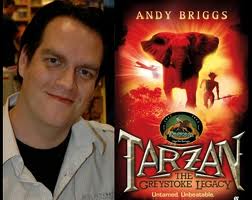
The Heroic Interview: Andy Briggs on Tarzan as Mythopoeic Legend

Tarzan.  For me the name echoes out of my childhood, evoking first of all the grainy black-and-white  images of an avidly watched TV series, secondly the garish pages of a comic and only thirdly the musty yellowing pages of an old book. In the end, it was the book I liked best. All of them have one thing in common, though - they showed me an indestructible hero, not dissimilar to the Greek ones I was obsessed with from the age of 8.  Although Tarzan is a twentieth-century construct he taps into that part of us which follows what Joseph Campbell called 'the thread of the hero path'.  Burne Hogarth, creator of that comic strip I mentioned above, called him, 'the elemental magma of the mythological stuff from which all ideal heroes spring.'  I don't disagree with that at all.

A true hero has many incarnations.  Edgar Rice Burroughs' original Tarzan book has spawned many reinventions, the latest of which is Andy Briggs' The New Adventures of Tarzan series.   I missed out on the first of those when it was published last year - and 'missing out' is exactly what I mean.  Tarzan: The Greystoke Legacy is a thrilling modern adventure - not only did it keep me on the edge of my seat, it also painted a graphic picture of the price that Africa pays for so-called civilised nations' greed. It's important that kids realise this early - and it's something that I feel passionately about.  Andy clearly does too, and he shows it in a clever way which is an integral part of the story, not an off-putting lecture. His Tarzan is built like a Greek god - but has none of the manipulative ways of one.  He is ruthlessly clear about right and wrong.  In his world animals and their natural habitat must be preserved - and the humans destroying them must be stopped.  If that means destroying them in their turn, then so be it. For all his uncompromising strength and power, though, this Tarzan has a touch of vulnerability and innocence about him which is peculiarly attractive.


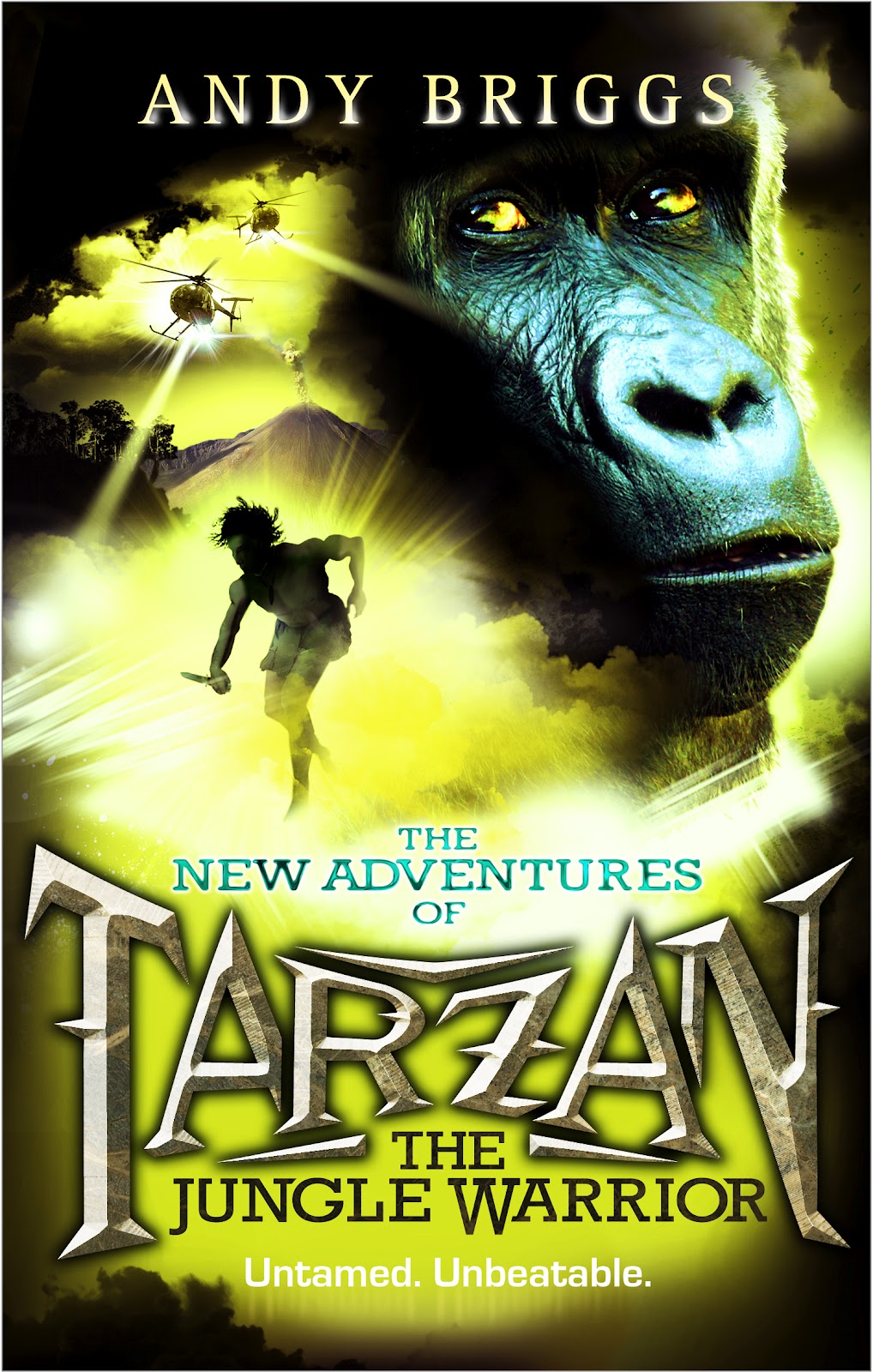
Tarzan: The Jungle Warrior has just been published by Faber. A vile Russian big-game hunter steals something very precious from Tarzan's world, and naturally he has to get it back, even though it means going closer to the world of humans than he's ever been.  It's just as edge-of-the-seat gripping as the first, and I very much liked that the characters of Jane and Robbie move on and develop in this book, as well as the friendship between Jane and Tarzan deepening.  I'll certainly be recommending both books to every boy I know.  They're tremendous, and I can't wait to see what happens next.  

Anyway, to celebrate the birth of this second in his reimaginings of the Tarzan legend,  and in keeping with Scribble City Central's reputation for discussing all things myth-related, I've asked Andy Briggs to talk about how he sees Tarzan's credentials as a modern mythic hero. Welcome, and over to you, Andy!


TARZAN - THE RISE OF A MYTH, THE BIRTH OF A HERO

AB: Africa; the cradle of civilization; the Dark Continent. A forge for myths and legends, and born in that violent merciless landscape: TARZAN. A boy raised by wild apes who became a noble lord... sound familiar? They’re the core ingredients for most iconic heroes. Romulus and Remus were twins born from a god and a princess, raised by wild wolves, who went on to found Rome. The rise of the underdog is a reoccurring theme in such stories, and one of Tarzan’s enduring traits.

Tarzan was lost in the jungle when his parents died and raised by an unknown species of intelligent ape. Now, let us hit the narrative pause button because in our enlightened times, we know this is nonsense. Or is it?  Burroughs wrote about the apes, calling them the Mangani, back in 1912. That was only ten years before Captain Robert von Beringe shot a pair of overly large apes during an African expedition. The bodies were later confirmed as a new species of gorilla, prior to that the tales of ape men were regarded as stuff of legend. Just like Bigfoot or the Yeti now. Sometimes, the pages of myth and legend transform into those of non-fiction and reality, and Tarzan was at the vanguard of that.

Tarzan rapidly became a heroic icon. His actions fuelled the public’s imagination and his image was recognised globally, as were his exploits. How did the Ape Man manage to achieve this when his predecessor, Mowgli, from the pages of Rudyard Kipling’s The Jungle Book, didn’t? Kipling’s tale was, and still is, a superb adventure, but what Mowgli lacks is the dark beast within that makes Tarzan not only a very human character, but also the ultimate hero.

Edgar Rice Burroughs wrote about a character that had survived against the odds. As a young boy, Tarzan had many run-ins with the other apes who kept him in check and a near fatal encounter with the lion, Sabor. Always tenacious, Tarzan never allowed himself to be subdued. It wasn’t until he discovered the wonders of the rope and knife that was he able to counter his human frailty and dominate, not only Sabor, but the alpha male apes who controlled the Mangani apes. Through superior intelligence and lethal weapons, Tarzan became Lord of the Jungle. He grew into the perfect physical specimen, the epitome of man - and he achieved all of this in his teenage years. The image of Tarzan as a 30 something hero comes from Hollywood. Adding up the years in Burroughs’ original, Tarzan was about 19 - and Jane, well, she was of “marry age”, which put her anywhere between 16 and 18.

For me, this was the joy of Tarzan. One man against the world; one man who could conquer all odds. A warrior who sought to defend the weak and uphold the balance of the world - interestingly, Tarzan was one of the first iconic heroes who didn’t battle for good. He had no concept of right or wrong; only balance which highlighted “good” and “bad” as nothing more than human concepts. By the end of Burroughs’ first Tarzan book, Tarzan of the Apes, Tarzan had embraced civilization and was driving around Baltimore, saving Jane from forest fires. That is an image few people, aside from serious Tarzan fans, would imagine. Seeing him in his English manor house reading the newspaper, is Burroughs’ Tarzan. Only by the third book, when Tarzan properly returns to the jungle, does he become the Tarzan that is still caught in the bubble of public perception - the Tarzan of legend - and that’s the Tarzan I wanted to write about.

I brought Tarzan back to his roots. Raised by wild animals, he is a feral creature; untamed. A man who eats raw flesh and can laugh one minute, then destroy the next such is his black and white view of the world. He knows his friends and he respects his enemies. In Tarzan’s world there are no grey areas, making him a formidable character. We don’t want our heroes to be indecisive emotional wrecks - that is a trapping of our modern world. Our classic heroes are swift, judgmental and not mired down by red tape or moral indecision. My Tarzan is not the English gentleman, with the Ape Man’s heart; mine is a strong, ruthless warrior.

In my new book, Tarzan: The Jungle Warrior I really wanted to see how such a mighty hero would cope with the pressures of our modern world. He pursues the world’s great hunter through the jungle and out on onto the African savannahs, eventually ending up in the bustling city of Kampala. Like a true hero, I found Tarzan was able to adapt to the worst I could throw at him. If anything he became more elemental, a ferocious force of nature. Sometimes so much so that I had troubling controlling him.

As a writer of 10 other children’s books and numerous screenplays, I don’t self-edit. However, since Tarzan is a primal character he tends not to tie the bad guys up and wait for the police to arrive. He delivers his own form of bloody justice. For the first time I found that Tarzan was forcing me to self-edit, particularly when he is faced with a poacher and armed with a recently severed elephant tusk...

Like all forces of nature, Tarzan cannot be bound by pages, public opinion or even old age. A legend cannot be tethered, it can only live on. Here’s to another 100 years of the Ape Man.

TARZAN: THE JUNGLE WARRIOR is out now, published by Faber. Can't wait to read it? Why not click on Scribble City Central Bookshelf and buy both books in the series?

Friday, 13 July 2012

FANTABULOUS FRIDAYS A-Z: H IS FOR HOB WITH PAT WALSH


Scribble City Central's twentieth Fantabulous Friday comes from Pat Walsh, shortlisted for both The Times Children's Fiction Competiton and the Waterstones Children's Prize. When I read Pat's first novel, The Crowfield Curse, I was entranced by the spot on historical mise-en-scène she creates.  I say mise-en-scène advisedly, even though it is a phrase more commonly used of film. Pat's writing is so rich and evocative that it was impossible for me not to see the people and places she describes unrolling quite clearly in my head as a sort of in-brain movie.


Not the least of these was William's hob, Brother Walter - a character she clearly loves down to the last tuft of reddish brown hair on his pointed ears.  I wasn't sure how she was going to follow such a fine book, but I needn't have worried.  The second Crowfield book - The Crowfield Demon - is darker, but just as much of a triumph. That feel of real medieval history touching the edges of the supernatural world is something Pat does brilliantly - to my mind these books have a flavour of Kevin Crossley-Holland's Seeing Stone trilogy (and that's a high compliment from me), but their originality is all Pat's own.   It is with great pleasure, therefore, that I pass you over to Pat to tell you all about:

H for Hob
Guardian and Forest Friend


PW:  I met my first hob between the pages of a book, many years ago. The book was Hobberdy Dick by KM Briggs. It was set during the English Civil War and told the story of a hob who looked after a manor house deep in the Cotswolds, and the families who lived there over the years. Witches and a Church Grim, an abbey lubber, ghosts and Will o’ the Wisps flitted through the story, lit by touchwood and corpse lights. It was a mixture that enchanted me and drew me back to the book time and again. Since then, I’ve come across other hobmen, a race of solitary fairy creatures ranging from the small and generally friendly brownies, lobs and hobthrusts to the more sinister Hob Headless and boggarts. We even know the names of some of these hobmen - Robin Goodfellow, Puck and Lob-lie-by-the-fire. They are to be found in the legends and folk tales of northern England and Scotland, and they turn up in fiction from time to time, always bringing an otherworldly sense of mystery and mischief to the proceedings. Amongst the best are Katherine Langrish’s hob in Dark Angels, Linda Newberry’s Lob (though Lob is as much a Green Man as a hob), and William Mayne’s hob in Hob and the Goblins.

‘Hob works when he lives in a house. He tidies away abandoned things, like scraps of quarrel, or pieces of spite. He banishes small troubles, makes ghosts happy, soothes tired curtains, charms kettles into singing, and stops milk sulking.’

This mixture of the cosily domestic and the magical underpins the lives of hobs and I knew long ago that I wanted to write a hob story of my own one day. In the meantime, I read and learned as much as I could about folklore and myths. The best reference book I ever found was A Dictionary of Fairies by Katharine Briggs (the same KM Briggs who wrote Hobberdy Dick). It has been my guidebook to the inhabitants of the Otherworld for more years than I care to remember.


I came across hobmen in other countries, though they went by different names: bwbach in Wales, domovoi in Russia, tontuu in Finland, kobold in Germany, and the Icelandic Yule Boys. I lived in Norway for several years and found an echo of our own home-grown hobs in the Scandinavian nisse and tomten, shy and gentle farm guardians who care for animals and children and keep the farmhouse and barns tidy and clean. A bowl of porridge or a piece of bread and butter is sufficient thanks for a hob’s hard work. But should the farmer offer clothing, then this kindly meant gesture is likely to offend, and the hob may well leave, never to be seen again.

In the Nordic countries these hobmen are an integral part of Christmas and appear in many children’s books, such as The Tomten and The Tomten and the Fox by the Swedish writer, Astrid Lindgren, and illustrated by Harald Wiberg. Wiberg’s snowy, moonlit illustrations perfectly capture the mood of the stories and introduce us to a small, bearded and red-capped tomten, a close cousin of the English hob, as he goes about his nightly work caring for the sleeping inhabitants of his farm.


When I started The Crowfield Curse, I decided that my own hob was going to be a forest creature, living in a burrow beneath an oak tree. In the story, circumstances conspire to bring the hob to a small abbey on the edge of the forest, where he makes friends with an orphaned boy and a crippled monk, and along the way, he gains a name, Brother Walter. From the outset, I saw him clearly in my mind; he was not the little bearded and clothed man of Scandinavian myth, or thin limbed and almost human in appearance like Hobberdy Dick. I saw Brother Walter as a small creature with thick reddish fur and a long tail. With his pointed ears and green-gold eyes, he has more of the fox about him than the gnome. He is inquisitive and fiercely loyal to those who earn that loyalty. He is hard working, as all hobs are, but like his fellow hobmen, he is essentially a wild creature who exists in the shadows beyond the edges of the everyday world. He is, as hobs have always been, a creature of magic and myth, a guardian spirit and a movement caught out of the corner of the eye.

Click here to buy both The Crowfield Curse and The Crowfield Demon on the Scribble City Central Bookshelf

SCC:  Hearing about where a writer's inspiration comes from never ceases to fascinate me.  Thank you so much, Pat.  I'm ashamed to say that I've never read Hobberdy Dick, so shall try and seek it out.

Next week: Steve Feasey, expert on all creatures of the Netherworld, talks about I for Imp.  See you then! 

Friday, 6 July 2012

FANTABULOUS FRIDAYS A-Z: G FOR GRIM WITH SUSAN PRICE


Scribble City Central's nineteenth Fantabulous Friday comes from Carnegie Medal winner, Susan Price.  To say I admire Sue's writing is a bit of an understatement.  I am in awe of her skill with a pen, and have been ever since I read The Ghost Drum Sequence over 20 years ago.


What she doesn't know about folklore and the wilder haunted bits of Britain is, basically, not worth knowing, and I can't think of a writer who pulls a reader into the atmosphere of the past more thoroughly.  For some reason I only came across Sue's Sterkarm books (which you'll find you can buy in the brand new Scribble City Central Bookshelf) fairly recently - and if you haven't read them, I suggest you remedy that omission forthwith. They took me straight into the world of the Border reivers, dirt, blood, death and all - and I can't recommend them highly enough. However, it's not cattle thieves Sue is telling us about today, but something even more scary - a Grim omen of death.  If the story in her post doesn't make you shiver deliciously, I don't know what will.  It's my great pleasure to hand you over to her to reveal the mysteries of:

G for The Grim
Death Dog of the Churchyard

SP
‘The sun sank and vanished and darkness gathered quickly… seemed to rise from among the gravestones, to come ducking out from beneath the low-hanging branches of the yew.  Mr Grimsby looked down his road home and saw it dwindling, fading in darkness…From the north side of the churchyard came trotting a dog, a big dog, and it fell in at his side. It was a black and shaggy dog, large of head and large of paw, and its back stood as high as Mr. Grimsby’s wide waist.  It looked up at him in the dusk and its eyes…gleamed red.“Hello boy… What a fine fellow you are, aren’t you?”“I’ll see you home,” said the dog… ”A story to shorten the way, since you’re a man for stories… What story shall it be?”
This comes from my collection of traditional stories, The Story Collector, which I hope to republish soon as an ebook.

Mr Grimsby is an elderly, retired man who amuses himself by collecting old stories from his servants and neighbours.  Here, as he pauses for a moment to rest, he meets a Churchyard Grim. The dog (or Grim) walks with Mr. Grimsby, telling a long and complicated tale to pass the journey.  (The story the Grim tells, if you’re curious, is ‘The Land Where All The Animals Say “Good Day!’)

At the story’s end, the Grim says, 
“And now we must say, ‘good day’…I can go with you no further.”With something of a start…Mr. Grimsby looked about him.  They stood before a tall door… “Where is this?... I don’t know this place.”“No,” said the dog. “But you’ll come to know it.”“I must go home,” Mr.Grimsby said, and turned to leave the strange door - but behind him was nothing but the utmost darkness… “Where are we?”“At the end of the world,” said the dog.  “That is Heaven’s Door.  Knock, and they’ll let you in.”And the… the Churchyard Grim, trotted back along the road… back to Earth, back to his church where, in the last darkness of the night, he slipped again into his own grave in the north side of the churchyard.To meet the…Churchyard Grim means that your own death will follow soon.

The Grim is a legend found all over Scandinavia and the British Isles.  It used to be believed, it’s said, that the first man buried in a new churchyard had to remain on Earth, to guard the church and its dead against the devil.  To spare a Christian this fate, and free them to salvation, a black dog was buried in the graveyard before any human dead.  The dog then became the Grim, or guardian spirit of the church.  (Behind this may lie the even older practice of burying a sacrifice or ancestor under a building.  Stone Age earthworks have been found with burials in their ditches, and Stone Age houses with graves under their floors.)

The Grim was usually buried on the churchyard’s north side – which was associated with things a little spiritually dubious.  The Devil’s power was strongest in the north.  Suicides were buried outside the churchyard wall, on the north side; and, in Scandinavia, if not elsewhere, women traditionally stood on the north side during services, to form a protective layer between men and the Devil.  (Women being more sinful anyway, were already closer to the Devil, and might as well be offered to him as a tidbit.)
Was the Grim buried on the north side because that was where a guard dog was most needed?  Or – as with women – was there felt to be some connection between the Grim and the Devil, or to older, pagan gods?

It’s been pointed out that the areas of England where the Black Dog walks are the areas where the Scandinavian influence is strongest, and the Black Dog may be Garmr, the watchdog who guards the gates of Hel, the underworld’s queen.  In Eddic poetry Garmr is also associated with Odin, and Odin was the lord of the dead.  The Romans referred to him as the Germanic Mercury – thus firmly identifying Him as a soul-leader, one who guides the dead to the next world.
Later, post-Christianity, Odin became the leader of the Wild Hunt, riding to hounds after lost souls.  But this was after Christianity had re-cast him as a devil.  If the Romans took a quick glance and readily identified him with their Mercury, who kindly guided the dead on their road, then Odin, originally, must have had a similar role.

And while the Black Dog is often thought of as sinister and death-dealing, there are kindly Black Dogs.  In Somerset the ghostly ‘Gurt Dog’ is said to protect children and also travellers, walking beside them through dangerous places and frightening away the ill-intentioned.  The Black Dogs of Lincolnshire are also gentle and protective.  In fact, the Black Dog is most malevolent and is called ‘Shuck’ (Devil) in those parts of Essex and Norfolk which were most puritan in the 17th Century, and most prone to label as ‘devilish’ anything that smacked of old, pre-Christian traditions.

Why does the Black Dog appeal to me?  Well, anything connected with Odin, that most fascinating and complicated of gods, appeals to me – but there’s also the fact that the Black Dog, in the form of Padfoot, walked the lanes of my childhood – those sooty little country-lanes trapped within the sprawl of the industrial Black Country.  And my Dad once met him!  He used to tell us the tale of how, walking home from a late night at work, he met the ghost dog – a story which I tell in my collection, Nightcomers

My Dad walked with Padfoot and lived to tell us the tale – but I think that when we have to take the road out of this life, there are worse ways to do it than in the company of a gurt, kindly black dog.  Especially if it tells a story to pass the time!

Susan Price blogs at http://susanpricesblog.blogspot.co.uk/ and also contributes to the Do Authors Dream of Electric Books blog  http://authorselectric.blogspot.co.uk/

SCC: As always, Sue, I've learnt something from you I didn't know about folklore.  That was a great post, and I shall now be very wary of dogs in churchyards.  Thank you so much for visiting.  

Next week: Pat Walsh, author of The Crowfield Curse talks about H for Hob. See you then! 

All books mentioned in SCC posts are now available to buy on the Scribble City Central Bookshelf.


Blog Design by Imagination Designs all images from the Before the First Snow kit by Lorie Davison